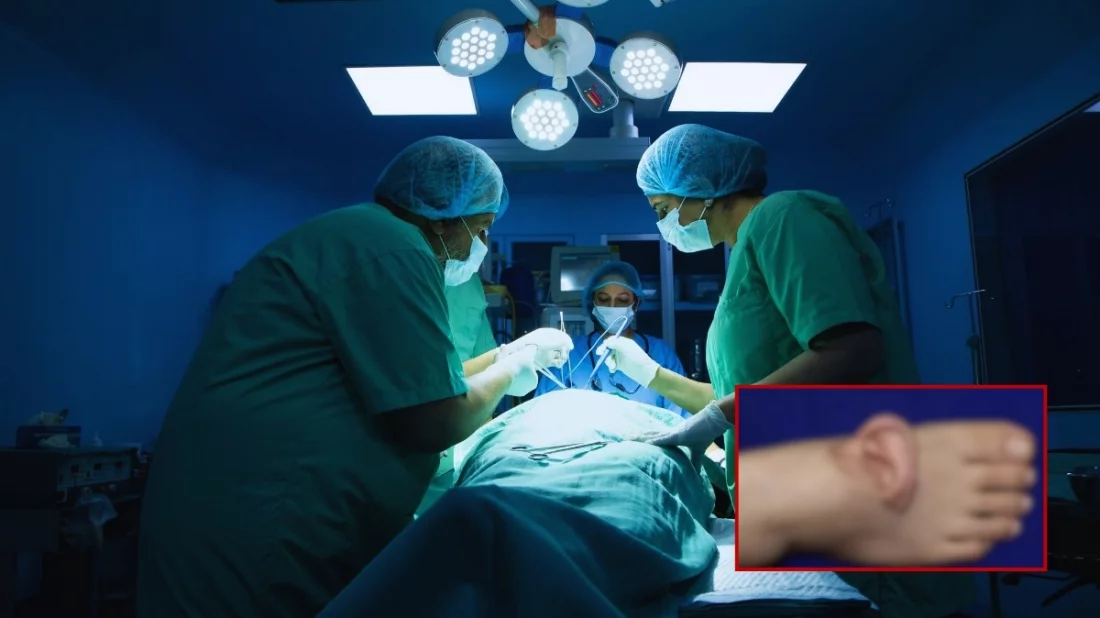
Chinese surgeons have achieved an extraordinary milestone in modern medicine by successfully preserving a woman’s completely severed ear on her leg and later reattaching it to its original position on her head. This highly complex and unprecedented surgical procedure has been hailed as a landmark achievement in the field of microsurgery.
According to a report by the Hong Kong–based South China Morning Post, the groundbreaking operation was performed by doctors at Shandong Provincial Hospital in Jinan, marking the world’s first successful case of this kind.
The incident occurred in April, when the woman suffered a severe workplace accident that resulted in her ear being completely torn off, along with extensive damage to the scalp. Due to the critical condition of the head tissues and blood vessels, immediate reattachment of the ear using conventional methods was deemed too risky and potentially life-threatening.
To keep the severed ear viable, the surgical team made a bold and innovative decision to temporarily graft it onto the upper part of the patient’s leg. This approach allowed continuous blood circulation, preventing tissue death while giving the scalp time to heal.
The lead surgeon and deputy director of the hospital’s microsurgery unit, Qiu Shenqiang, explained that the vascular network in the patient’s head was severely damaged, making direct reattachment impossible at that stage. The leg was chosen because its arteries and veins are anatomically compatible with the tiny blood vessels of the ear.
The initial surgery lasted nearly 10 hours, during which surgeons meticulously connected blood vessels measuring just 0.2 to 0.3 millimeters in diameter. Over the following month, keeping the ear alive and functional remained the team’s greatest challenge.
Five days after the procedure, venous circulation problems caused the ear to turn dark purple, signaling a high risk of tissue failure. In response, doctors employed an extremely labor-intensive technique, performing controlled bloodletting nearly 500 times over five days to restore healthy blood flow and save the ear.
Meanwhile, another surgery was carried out to repair the patient’s scalp using skin grafts taken from her abdomen. After five months, once the head wound had fully healed and the ear on the leg remained healthy, doctors proceeded with the final stage of treatment.
In October, a six-hour microsurgical operation successfully reattached the preserved ear from the leg back to its original position on the patient’s head.
The patient, identified by the pseudonym Sun, has since been discharged from the hospital and returned home. Doctors report that the function and appearance of her ear and facial tissues are now nearly normal. Although minor procedures remain—such as eyebrow reconstruction and reducing scarring on the leg—the most critical and complex phases have been successfully completed.
Medical experts worldwide are viewing this case as a unique and historic example of innovation, precision, and surgical skill. Physicians believe this breakthrough offers new hope for the future restoration of severed body parts and represents a significant advancement in reconstructive and microsurgical medicine.