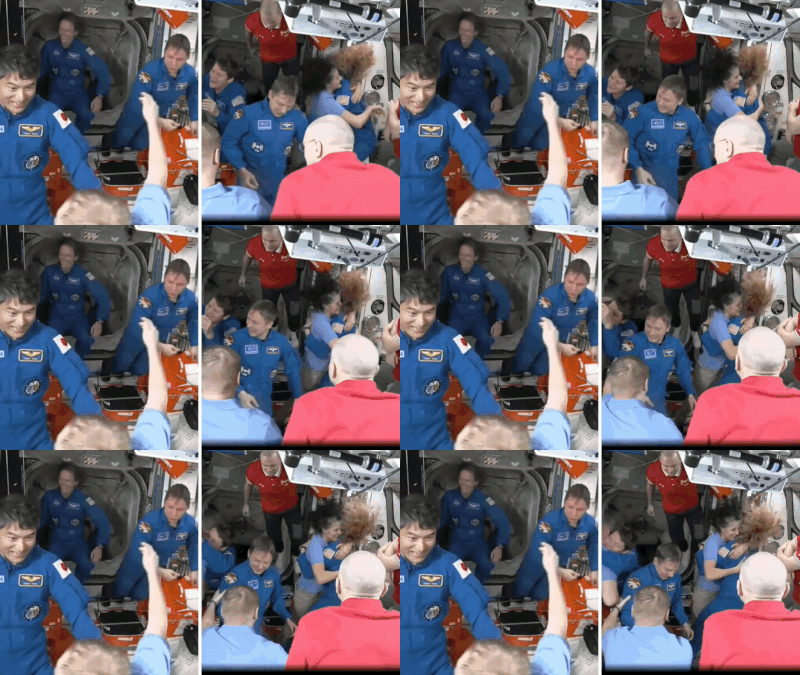
In a significant milestone for space exploration, SpaceX’s Crew Dragon capsule successfully docked with the International Space Station (ISS) on Sunday, bringing much-needed relief to NASA astronauts Sunita Williams and Butch Wilmore. The two astronauts have been stranded in orbit for over nine months due to technical complications with their original return vehicle. The successful arrival of Crew-10 has paved the way for their long-awaited return to Earth.
Crew-10 Team Arrives at ISS
The newly arrived Crew-10 team, comprising NASA astronauts Anne McClain and Nichole Ayers, Japan Aerospace Exploration Agency’s (JAXA) Takuya Onishi, and Roscosmos cosmonaut Kirill Peskov, has joined the ISS to replace Williams and Wilmore. The Crew-10 team was seen on live television warmly embracing their counterparts in zero gravity, symbolizing the transition of responsibilities aboard the station.
Their arrival marks the beginning of the transition period, during which the Crew-10 members will acclimate to life on the ISS and take over the scientific research and operational tasks previously handled by Williams and Wilmore. This change of crew ensures the continued functioning of the space station while enabling the overdue return of the two astronauts.
Extended Stay on the Space Station
Sunita Williams and Butch Wilmore originally launched aboard Boeing’s Starliner capsule as part of its maiden flight. However, unforeseen technical difficulties prevented their planned return, forcing them to remain on the ISS much longer than anticipated. Their stay was extended further when additional battery repairs were required for their replacement capsule, delaying their return by several weeks.
The Starliner program, which was developed under NASA’s Commercial Crew Program, faced multiple setbacks during its test phase. The capsule experienced software anomalies and hardware malfunctions, including propulsion issues and navigation system failures. These problems led to significant delays, raising concerns about the reliability of the spacecraft for long-duration missions.
Despite the unexpected extension of their mission, both astronauts have remained committed to their work, contributing to scientific research and station maintenance throughout their prolonged stay. They played a critical role in conducting experiments related to microgravity’s impact on human health, advanced materials research, and biological studies that could benefit future deep-space missions.
The Road Ahead
With the successful docking of Crew Dragon, NASA and its international partners have now shifted their focus to completing the return mission for Williams and Wilmore. The Crew-10 team will continue station operations, while final preparations are being made for the departure of the two stranded astronauts.
Williams and Wilmore are expected to board the SpaceX capsule later this week for their long-awaited return to Earth. NASA officials have emphasized that every precaution is being taken to ensure a smooth and safe descent back home. The Crew Dragon capsule is equipped with state-of-the-art re-entry systems, advanced thermal shielding, and precision landing capabilities, ensuring a secure splashdown in the designated recovery zone.
NASA and SpaceX recovery teams will be stationed at multiple locations in the Atlantic Ocean and Gulf of Mexico, prepared to retrieve the capsule upon landing. Medical personnel will be on-site to assess the astronauts’ health after their extended stay in space, ensuring they are fit for reintegration into Earth’s gravity environment.
Lessons Learned and Future Missions
This event highlights the complexities and challenges of human spaceflight, especially with the introduction of new commercial spacecraft into NASA’s operations. The extended mission of Williams and Wilmore has provided valuable insights into spacecraft endurance, astronaut adaptability, and emergency contingency planning. It has also reinforced the importance of redundancy in spaceflight systems and rigorous testing before deploying new vehicles.
NASA remains committed to advancing its human spaceflight capabilities with upcoming missions, including Artemis, which aims to return humans to the Moon, and future deep-space exploration efforts targeting Mars. The lessons learned from the challenges faced by Williams and Wilmore will help refine protocols for extended space missions, ensuring safer and more efficient operations for future astronauts.
With the return of Williams and Wilmore on the horizon, the space community eagerly anticipates their safe arrival, marking the conclusion of an extraordinary and unexpected chapter in space exploration. Their resilience and dedication serve as a testament to the spirit of human exploration, pushing the boundaries of what is possible in the pursuit of scientific discovery and space travel advancements.