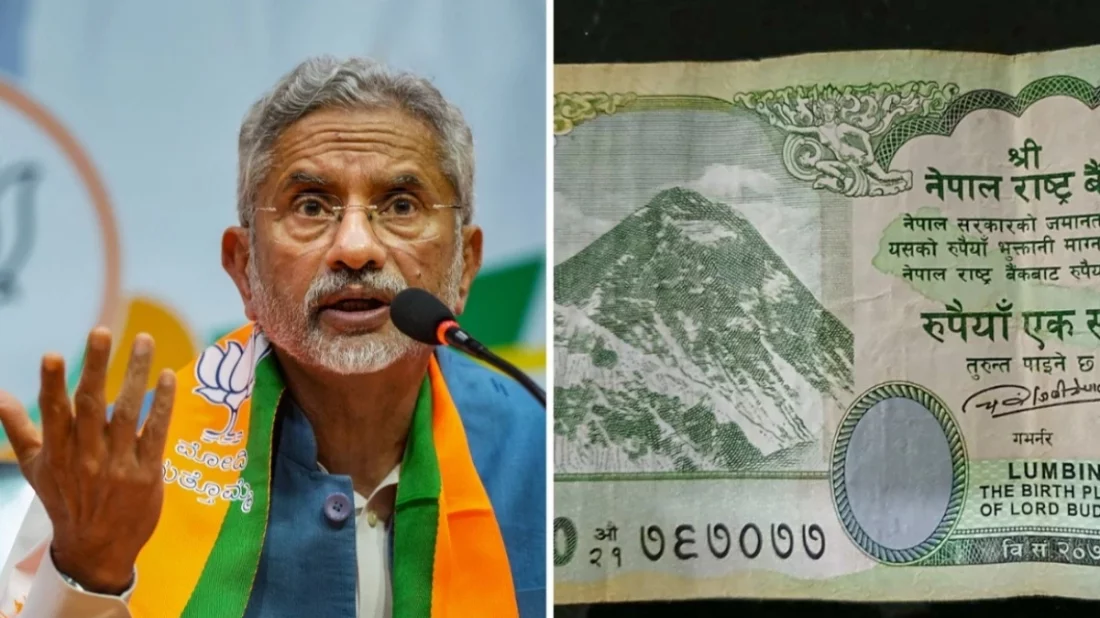
The Nepal Rastra Bank (NRB), the country’s central bank, has introduced a newly designed 100-rupee banknote that has already triggered renewed geopolitical debate in the region. The new note, released on Thursday (27 November), prominently features Nepal’s revised national map, which includes the disputed territories of Kalapani, Lipulekh, and Limpiyadhura—areas currently controlled by India and claimed by both countries.
This rollout comes during a politically turbulent period in Nepal. Following months of intense Gen Z–led protests and the subsequent fall of the Oli government, an interim administration headed by Sushila Karki has taken charge. Under this interim government, NRB moved forward with issuing the redesigned currency.
The note bears the signature of former NRB Governor Maha Prasad Adhikari and is dated Nepali year 2081, corresponding to 2024 in the Gregorian calendar.
Background of the Dispute
The territorial dispute between India and Nepal over Kalapani, Lipulekh, and Limpiyadhura is long-standing. These regions lie near the tri-junction of Nepal, India, and China and have strategic significance.
In May 2020, during the tenure of Prime Minister K.P. Sharma Oli, Nepal released a revised political map asserting these territories as part of its sovereign domain. Parliament later approved this map, making it an official representation of the state.
India, however, strongly objected to the move, labeling it a “unilateral act” that ignored historical realities and existing border agreements. New Delhi cautioned Kathmandu that such “artificial enlargement of territorial claims” was unacceptable and counterproductive to bilateral relations.
Features of the New Banknote
According to an NRB spokesperson, the map used on the note is not entirely new; it existed on the earlier version of the 100-rupee note but has now been updated in accordance with the government’s revised mapping policy.
Notably, the 100-rupee denomination is the only Nepali banknote that features the national map—other denominations such as 10, 50, 500, and 1,000 rupees do not include it.
Key design elements of the new note include:
- Left side: An image of Mount Everest
- Right side: A watermark of Nepal’s national flower, the Rhododendron
- Center: A pale green outline of the updated map showing the disputed regions
- Beside the map: The Ashoka Pillar, marked with the inscription “Lumbini, the birthplace of Lord Buddha”
- Back side: A depiction of a one-horned rhinoceros, one of Nepal’s iconic wildlife species
- Additional security features include a security thread and a black dot for authentication.
India’s Reaction
India has reacted sharply to Nepal’s decision to use the revised map on its currency. Indian External Affairs Minister S. Jaishankar denounced the move, calling it a “unilateral step” that complicates an already sensitive bilateral issue. New Delhi maintains that these territories belong to India, citing administrative control and historical records dating back to the British colonial period.
Regional Implications
Nepal shares more than 1,850 kilometers of open border with five Indian states—Sikkim, West Bengal, Bihar, Uttar Pradesh, and Uttarakhand. Given the close social, economic, and cultural links between the two countries, any escalation in territorial disputes has the potential to strain relations further.
Analysts suggest that Nepal’s decision to place the disputed map on its currency could intensify diplomatic tensions at a time when both nations are navigating complex political and strategic challenges.
Sources: NDTV, India Today