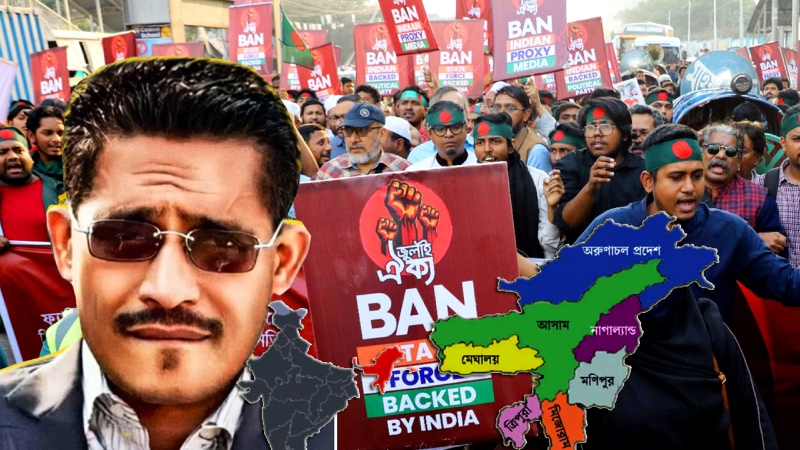
Dhaka witnessed a renewed surge of political agitation on Wednesday as thousands of students and activists associated with the July mass uprising rallied under the banner of “July Unity”, marching toward the Indian High Commission with fierce slogans, sharp warnings to the interim government, and strong denunciations of India’s alleged role in sheltering figures accused of crimes against humanity in Bangladesh.
The atmosphere in the capital echoed the turbulence of last July. Chanting crowds gathered amid tight police barricades, filling the air with emotionally charged slogans such as: “Break the India that shelters killers,” “Delhi or Dhaka—Dhaka, Dhaka,” “No to subservience, yes to freedom,” and “Compromise or resistance—resistance.” Some slogans also invoked historical and geopolitical imagery, including calls for the “liberation of the Seven Sisters,” reflecting the intensity of popular anger and nationalist sentiment among demonstrators.
March Halted, Protest Turns Into Mass Rally
The program, titled “March to the Indian High Commission,” began in the afternoon from Rampura Bridge. Participants included students from universities, colleges, madrasas, and schools, former military officers, and leaders from student bodies such as DUCSU and JACSU. As the procession advanced toward Middle Badda, police intervened and blocked further movement. Unable to proceed, protesters halted at the site, where the march transformed into a large public rally attended by thousands.
Organizers said the protest was called to demand the extradition of individuals accused of crimes against humanity during the July uprising—most notably former Prime Minister Sheikh Hasina, who, according to the protesters, has been sentenced to death and is currently in exile in India. Demonstrators also protested what they described as continued conspiracies by “Indian proxy political forces, media networks, and officials” to influence Bangladesh’s internal affairs.
Leaders Accuse India of Sheltering Accused Killers
Addressing the rally, AB Zubayer, organizer of July Unity and former DUCSU Social Welfare Secretary, alleged that since the July 2024 mass uprising, “Indian proxies have intensified conspiracies against Bangladesh.” He accused India of providing shelter to those responsible for mass killings during the uprising and criticized the lack of progress in arresting perpetrators and recovering weapons allegedly used against student protesters.
Referring to the attempted killing of activist Sharif Osman Hadi, Zubayer said that the failure to arrest suspects demonstrated the government’s inability to deliver justice. He warned the interim authorities that they were not installed “on the blood of two thousand students” to protect those accused of crimes. “If Sheikh Hasina cannot be brought back from India to face justice,” he said, “then those who enable this impunity will also be made to stand in the dock of history.”
Zubayer described Wednesday’s march as a symbolic expression of anger, adding ominously that if authorities failed to correct course, future protests would escalate. His remarks drew loud applause and chants from the crowd.
Allegations of Indian Interference and Political Lobbying
Another organizer, Mosaddeq Ali Ibn Mohammad, former DUCSU Literature and Cultural Secretary, directly linked the attempted assassination of Osman Hadi to India, claiming that suspects were found there. “What does this mean?” he asked rhetorically. “Who fired the bullet? This bullet came from India,” he said, framing the incident as evidence of external interference.
Mosaddeq also accused India of covert efforts to rehabilitate the Awami League through lobbying and diplomatic channels. He alleged that Bangladesh’s security adviser had held secret meetings with Indian officials and described this as a betrayal of the July martyrs. Criticizing Foreign Affairs Adviser Md. Touhid Hossain, Mosaddeq said the government had failed to issue strong diplomatic protests over border killings or to take visible steps to secure the return of accused fugitives.
Issuing stark warnings, Mosaddeq said that if demands were ignored, future demonstrations would be more confrontational. He threatened mass actions targeting diplomatic missions and called for the expulsion of Indian diplomats—statements that were met with thunderous chants from sections of the crowd.
“A Warning, Not the End”
Israfil Farazi, another organizer of July Unity, described the march as a “warning signal.” He claimed that India had hired lobbyists on behalf of the Awami League and that efforts were underway—both domestically and through foreign embassies—to reinsert the party into power.
“Today we came in thousands; next time we will come in hundreds of thousands,” Farazi said. “If Sheikh Hasina and others accused of killings are not returned to face justice, the coming days will not be comfortable for India.” He cautioned the administration against underestimating the movement’s momentum.
Rising Tensions, Uncertain Path Ahead
The protest ended without major clashes, but its rhetoric underscored rising tensions at a sensitive moment for Bangladesh’s domestic politics and regional diplomacy. While the demonstrators framed their actions as patriotic resistance and a demand for justice, the language used—particularly threats and calls targeting diplomatic missions—raised concerns among observers about escalation and stability.
As night fell over Dhaka, police maintained a heavy presence in the area, and July Unity leaders vowed that this was only the beginning. Whether the interim government responds with diplomatic initiatives, legal actions, or restraint remains to be seen, but Wednesday’s events made one thing clear: the legacy of the July uprising continues to shape Bangladesh’s political streets—and its message is growing louder.