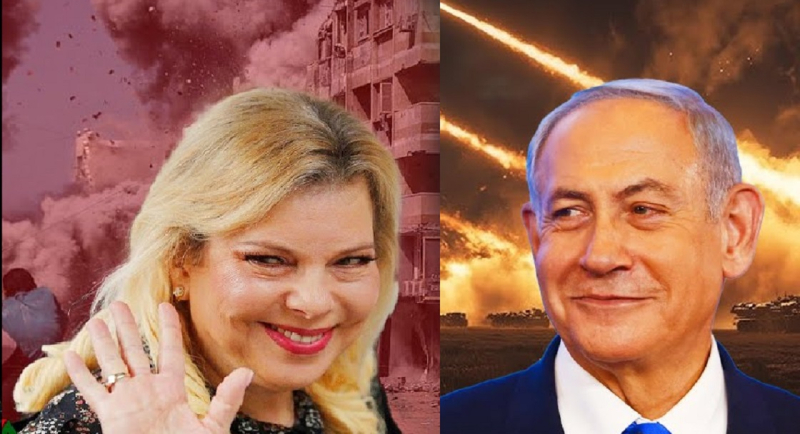
Israeli Prime Minister Benjamin Netanyahu has long been one of the most polarizing figures in modern politics. A dominant force in Israeli leadership for decades, he has built his political career on a mixture of hardline security policies, populist rhetoric, and appeals to Jewish historical memory. Yet his recent remarks in New York, made during an event at the Israeli Consulate, have triggered a storm of criticism unlike most others.
With Gaza engulfed in bloodshed and the West Bank simmering with tension, Netanyahu told his audience, half in jest, that his wife, Sara Netanyahu, dictates when and where Israel carries out its military strikes. “My wife decides when and where we attack,” he quipped. He then added that Israel’s modern-day “resurgence” and military might would not have been possible without her guidance.
The remark might have been intended as humor, but its timing and context have given it a gravity that cannot be ignored. Critics say it trivializes the deadly consequences of Israel’s military campaigns and raises uncomfortable questions about the seriousness of decision-making in one of the world’s most volatile regions.
A Joke That Fell Flat
Political leaders often employ humor in public forums, particularly in international settings, as a way to humanize themselves and lighten tense atmospheres. Netanyahu is no stranger to using humor as a rhetorical device. But unlike self-deprecating jokes about age or family life, quips about military strikes—especially in the midst of a war that has left thousands of civilians dead—carry a different weight.
“It was tone-deaf, to say the least,” noted Dr. Hanan Ashrawi, a Palestinian academic and former member of the Palestinian Legislative Council. “Thousands of women and children are buried under rubble, and he makes jokes about who orders the bombs. Even if he meant it lightly, it reveals the deep callousness of the leadership.”
International observers agree. In an analysis published by Haaretz, Israeli columnist Anshel Pfeffer argued that Netanyahu’s remark reflects his tendency to blur lines between the personal and the political—a trait that has long characterized his leadership style. “Whether it was a joke or not is almost beside the point,” Pfeffer wrote. “What matters is that it projects an image of unseriousness at a moment when Israel desperately needs credibility on the world stage.”
The Historical Backdrop: Netanyahu and the Use of Narrative
Netanyahu has often framed Israel’s military actions through the lens of Jewish historical trauma. In New York, he once again invoked the long history of Jewish persecution, claiming that Jews have endured centuries of humiliation, discrimination, and violence, but now—thanks to the strength of the Israel Defense Forces (IDF)—they finally “hold the sword.”
This rhetoric fits a well-established pattern. Netanyahu frequently draws parallels between modern conflicts and the persecution of Jews throughout history, from biblical exile to the Holocaust. While this framing resonates with many Israelis who see their state as a bastion of survival in a hostile region, critics argue that it reduces complex political struggles to a simplistic narrative of eternal victimhood versus aggression.
“Netanyahu thrives on historical analogies,” explained Professor Avi Shlaim of Oxford University. “But history is not a political blank check. To justify modern wars by invoking ancient suffering is to misuse history in service of state violence.”
The Gaza War: A Backdrop of Human Suffering
The controversy comes amid one of the deadliest Israeli operations in Gaza in recent history. According to United Nations reports, tens of thousands of Palestinians have been killed since the conflict escalated, with a staggering proportion of the casualties being women and children. Civilian infrastructure—schools, hospitals, residential blocks—has been destroyed, leaving Gaza teetering on the edge of humanitarian collapse.
The Israeli government defends these operations as necessary to neutralize Hamas and other militant groups. Netanyahu, in particular, has repeatedly insisted that Israel’s actions are about self-defense and the preservation of Jewish security. But his quip about Sara Netanyahu’s influence casts these decisions in an unsettlingly personal light.
“If the prime minister can imply that his spouse decides when missiles fly, it suggests a trivialization of military decisions that cost human lives,” said Kenneth Roth, former executive director of Human Rights Watch. “Even if it was a joke, the optics are devastating.”
Provocation Toward the Arab World
Equally incendiary was Netanyahu’s direct attack on Arab nations during the same speech. He claimed that the widespread narrative—that Jews displaced Arabs from their land during the creation of Israel—was a fabrication. “The first lie is that Jews expelled Arabs from their land. The truth is the opposite: Arabs expelled Jews from theirs,” he declared.
This reframing of history is not new in Israeli discourse, but its repetition in an international setting underscores the hardening of Netanyahu’s rhetorical stance. Analysts warn that such claims further erode the possibility of reconciliation with Arab states.
“Statements like these don’t just distort history—they actively fuel animosity,” said Dr. Rashid Khalidi, Edward Said Professor of Modern Arab Studies at Columbia University. “When the Arab world already views Israel as an occupying power engaged in ethnic cleansing, remarks like this slam the door on any possibility of trust.”
International Reaction and Diplomatic Fallout
The United Nations and leading humanitarian organizations have already issued sharp condemnations of Israel’s military campaign in Gaza. The International Criminal Court (ICC) has even indicated that Israel could face investigations for potential war crimes. Against this backdrop, Netanyahu’s remarks risk deepening Israel’s diplomatic isolation.
European Union officials described his comments as “deeply troubling” and “undermining the seriousness of Israel’s military posture.” Even within the United States—Israel’s staunchest ally—there is growing unease. A group of Democratic senators has already called for conditioning military aid to Israel on human rights standards, a position once considered unthinkable in Washington.
“In diplomacy, words matter,” said Richard Haass, former president of the Council on Foreign Relations. “When a leader jokes about decisions of war and peace, especially amid allegations of war crimes, those words are weaponized by critics and adversaries. It makes Israel’s position in the international system more precarious.”
Netanyahu’s Leadership Style and the Role of Family
Netanyahu’s close reliance on his wife Sara is no secret in Israeli politics. She has long been portrayed, both by supporters and critics, as an influential figure in his decision-making circle. Over the years, Sara Netanyahu has been accused of interfering in political appointments and even policy discussions. In 2019, she faced legal scrutiny for misusing state funds, though she has denied all wrongdoing.
Some analysts argue that Netanyahu’s comment in New York was a veiled acknowledgment of this dynamic. “Sara Netanyahu has always been more than a spouse—she’s a political partner,” observed Israeli journalist Ben Caspit. “The problem is not her influence per se, but the lack of transparency. When leaders blur the line between private advice and public policy, it creates uncertainty about who is actually governing.”
Geopolitical Implications
The timing of Netanyahu’s remarks could hardly be worse. The Middle East is already at a boiling point, with Iran, Hezbollah, and other actors closely watching Israel’s every move. Meanwhile, Arab states that had cautiously entered into normalization agreements with Israel under the Abraham Accords are now under domestic pressure to sever ties due to the Gaza war.
By invoking historical grievances against Arabs and framing Jewish power as a “sword,” Netanyahu risks inflaming nationalist sentiments across the region. Analysts warn that this could derail fragile peace processes and embolden extremist actors who thrive on the perception of Israel as an unrepentant aggressor.
“Every word Netanyahu says reverberates across the region,” noted Dr. Trita Parsi, co-founder of the Quincy Institute for Responsible Statecraft. “When he jokes about war and casts history as a zero-sum struggle, he provides rhetorical ammunition for those who want permanent conflict rather than peace.”
Conclusion: Words as Weapons
Whether Benjamin Netanyahu intended his New York remarks as humor or not, the consequences are undeniable. By joking that his wife directs Israel’s military strikes, he has trivialized matters of life and death at a time when Israel is under unprecedented international scrutiny. By reframing Jewish-Arab history in starkly antagonistic terms, he has deepened the chasm between Israel and its neighbors.
In politics, words are never just words. For a leader commanding one of the world’s most powerful militaries in one of its most volatile regions, they can function as weapons in their own right. Netanyahu’s latest remarks may not have altered military policy, but they have reshaped the diplomatic battlefield, leaving Israel more isolated and mistrusted than before.
As one veteran Israeli diplomat put it privately: “Netanyahu thinks he’s being clever when he jokes. But in today’s world, every word is a missile—and this one hit Israel itself.”