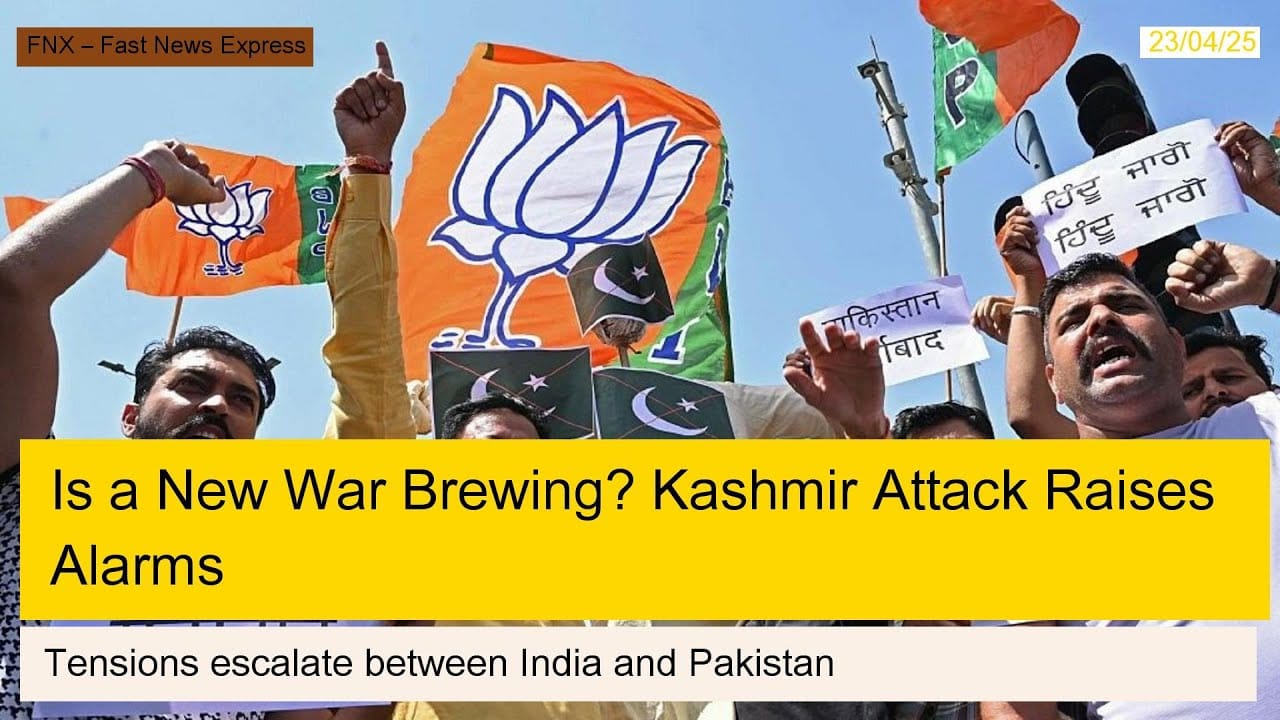
Tensions between India and Pakistan—two nuclear-armed neighbors in South Asia—have periodically flared since their independence from British colonial rule in 1947. Now, once again, a series of political, military, and diplomatic signals are raising fears of renewed confrontation. Is the subcontinent on the verge of another major conflict, or can diplomacy hold the line?
A Legacy of Is a New India-Pakistan Conflict Brewing?
India and Pakistan have fought three full-scale wars (1947–48, 1965, and 1971) and a limited conflict in Kargil in 1999. The epicenter of this prolonged hostility is the Kashmir region, claimed in full by both nations but currently administered in parts by each. In 2019, India abrogated Article 370 of its constitution, revoking Jammu and Kashmir’s special autonomy—a move Pakistan condemned as illegal and provocative.
The bitterness runs deep. From the 2001 Indian Parliament attack to the 2008 Mumbai terror attacks and the 2016 Uri attack, cross-border militancy has intensified distrust. India’s surgical strikes in 2016 and airstrikes in Balakot in 2019 were unprecedented responses, shifting India’s security doctrine from “strategic restraint” to a more assertive approach.
References:
- Ganguly, S. & Kapur, S. P. (2010). India, Pakistan, and the Bomb: Debating Nuclear Stability in South Asia. Columbia University Press.
- Ministry of External Affairs, India (2019). “Government Statement on Article 370”.
What’s Fueling the New Tensions?
- Ceasefire Violations
Despite a 2021 ceasefire agreement, the Line of Control (LoC) has seen increased firing incidents. According to Indian Army sources, over 100 ceasefire violations were reported in early 2024 alone. Pakistani authorities have countered with claims of Indian provocation.
Reference:
- Indian Ministry of Defence Reports (2024)
- Pakistan Inter-Services Public Relations (ISPR) Press Briefings
- Political Rhetoric and Nationalism
The rise of nationalist sentiment in India under the Bharatiya Janata Party (BJP), led by Prime Minister Narendra Modi, has been mirrored by hawkish statements from Pakistan’s military establishment and political leaders. Modi’s recent remarks on “reclaiming Pakistan-occupied Kashmir” were met with strong rebuttals from Islamabad, with the Pakistan Army warning of a “befitting response.”
Reference:
- The Hindu (March 2025), “PM Modi Reasserts PoK Claim”
- Dawn (March 2025), “Pakistan Army Chief Responds to Indian Provocation”
- Militancy in Kashmir
Security forces in India have reported an uptick in infiltration attempts along the LoC. The recent attack in Poonch (March 2025) that killed five Indian soldiers has been blamed on Pakistan-backed militants, though Pakistan has denied involvement.
Reference:
- Reuters (March 2025), “India Accuses Pakistan of Backing Kashmir Attack”
- Diplomatic Freeze
Diplomatic dialogue is at a near-standstill. The backchannel talks brokered by the UAE in 2021 collapsed in 2023 following India’s rejection of any third-party mediation in Kashmir. This diplomatic vacuum increases the likelihood of miscommunication and miscalculation.
Reference:
- Al Jazeera (2023), “Secret UAE-mediated Talks Collapse”
- Hindustan Times (2024), “India Rules Out Third-Party Mediation”
- Geopolitical Realignments
China’s expanding influence, particularly through the China-Pakistan Economic Corridor (CPEC), has heightened India’s security concerns. Meanwhile, India’s strategic defense ties with the United States, Japan, and Australia under the Quad framework are seen by Islamabad and Beijing as containment efforts.
Reference:
- Council on Foreign Relations (2024), “Quad’s Strategic Implications for South Asia”
- Brookings Institution (2024), “CPEC and Regional Stability”
The Nuclear Angle
Both India and Pakistan are estimated to have over 150 nuclear warheads each, according to the Federation of American Scientists. A limited war, such as the one envisioned under India’s “Cold Start” doctrine, could potentially escalate into a catastrophic exchange if mismanaged.
Former U.S. President Bill Clinton once called Kashmir “the most dangerous place in the world” due to the nuclear risk—a warning that still resonates today.
Reference:
- Federation of American Scientists (2024), “Nuclear Notebook: India and Pakistan”
- BBC Archives (2000), “Clinton: Kashmir Most Dangerous Flashpoint”
Is War Inevitable?
Despite the tension, a large-scale war seems improbable—at least for now. Economic constraints, international pressure, and the enormous human cost of conflict act as deterrents. However, the threat of accidental war due to miscalculation or a terrorist trigger cannot be discounted.
The Road Ahead: Diplomacy or Disaster?
For sustainable peace, both nations need to:
- Resume bilateral dialogue under agreed frameworks like the 2003 ceasefire accord.
- Strengthen Track II diplomacy involving civil society, academia, and media.
- Increase transparency in military movements and avoid provocative exercises near the border.
- Engage with international mediators informally to build trust.
The need for a peace process has never been more urgent. The stakes—regional security, economic progress, and millions of lives—are simply too high to ignore.
As the subcontinent stands on the edge of uncertainty, only wise diplomacy and courageous leadership can prevent a descent into chaos. India and Pakistan have a choice: continue the cycle of conflict or break free from the past to forge a new future. The world watches closely.