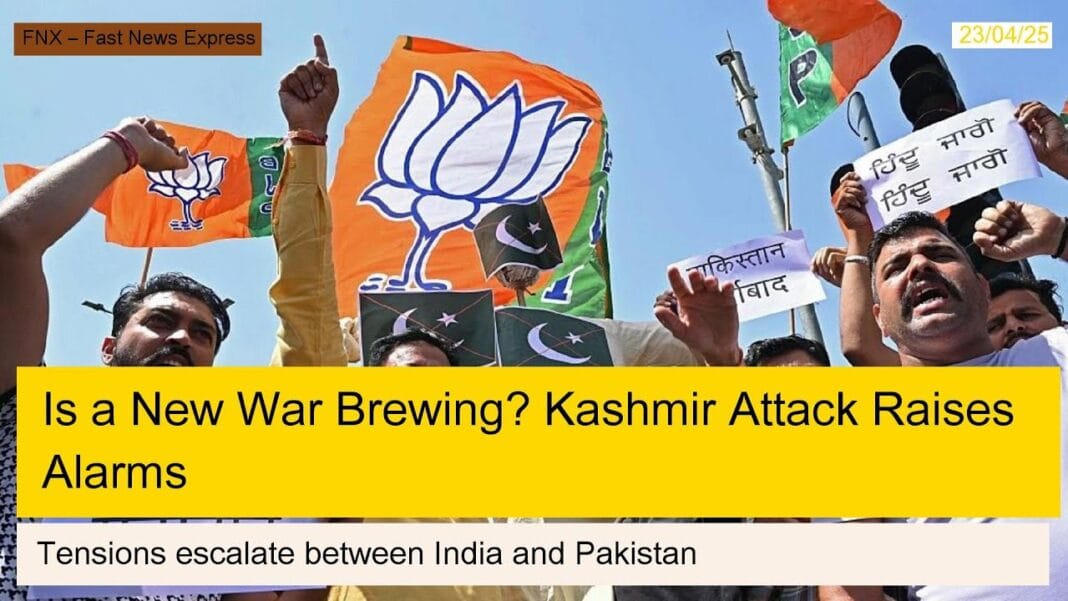
The fragile peace between nuclear-armed neighbors India and Pakistan is under fresh threat following India’s suspension of the Indus Waters Treaty, a move that has drawn a fiery response from Pakistan’s former foreign minister and Pakistan People’s Party (PPP) chairman, Bilawal Bhutto Zardari.
Addressing a charged gathering in Sukkur along the banks of the Indus River, Bilawal issued a chilling warning to India: “The Indus belongs to Pakistan and will remain ours. If India stops the flow of water, Indian blood will flow instead.”
Bilawal accused Indian Prime Minister Narendra Modi of using Pakistan as a scapegoat for internal failures and attempting to divert public attention by escalating tensions. “Modi has made false allegations against Pakistan to hide his government’s weaknesses and to fool the Indian people,” he said, standing beside the mighty Indus — a symbol of life and sovereignty for Pakistan.
Context: The Pahalgam Attack and India’s Response
The backdrop of these tensions is the terrorist attack in Pahalgam, Jammu and Kashmir, which left 26 people dead earlier this month. Indian intelligence agencies have attributed the attack to Pakistan-based terror groups, prompting a furious reaction from New Delhi.
In an emergency session of the Cabinet Committee on Security (CCS) chaired by Prime Minister Modi, India announced a series of strong retaliatory measures:
- Suspension of the Indus Waters Treaty — one of the most critical water-sharing agreements globally.
- Closure of the Integrated Check Post at Attari — cutting off key land-based people-to-people links.
- Cancellation of the SAARC Visa Exemption Scheme (SVES) visas — removing visa-free travel privileges for Pakistani nationals.
- Reduction of Pakistani diplomatic staff — slashing the High Commission’s size in New Delhi from 55 to 30 officials.
Debashree Mukherjee, India’s Secretary of Water Resources, formally communicated the decision to Islamabad, citing Pakistan’s “breach of the treaty’s conditions through sustained cross-border terrorism.”
Pakistan’s Reaction: “Water Warfare”
Pakistan’s government immediately lashed out. Awais Leghari, Pakistan’s Federal Minister for Power, condemned the move, describing it as “an act of water warfare” and calling it a “cowardly and illegal step” that violates international norms.
Pakistani media and opposition parties have also rallied around the issue, warning that India’s actions could destabilize the region further. Many experts in Pakistan fear that any disruption to the flow of Indus waters could devastate Pakistan’s agriculture sector, which depends heavily on irrigation from the river system.
The Indus Waters Treaty: A Cornerstone Under Threat
Signed in 1960 after nearly a decade of negotiations brokered by the World Bank, the Indus Waters Treaty is widely regarded as one of the most successful examples of conflict resolution between hostile neighbors.
Under the treaty:
- India was given control over the eastern rivers — Sutlej, Beas, and Ravi.
- Pakistan received the rights over the western rivers — Indus, Jhelum, and Chenab.
The treaty also established a Permanent Indus Commission for conflict resolution, technical cooperation, and information sharing. Remarkably, the treaty survived the 1965 and 1971 India-Pakistan wars and even the 1999 Kargil conflict.
However, growing anger in India over repeated terrorist attacks has led to increasing calls within the country to re-examine or even revoke the treaty. Hardline political voices argue that Pakistan cannot expect water cooperation while allegedly sponsoring terrorism across the border.
Broader Regional Implications
The suspension of the Indus Waters Treaty could have grave consequences beyond bilateral relations:
- Food Security Threat: Pakistan is heavily reliant on the Indus system for irrigation. Disruptions could trigger agricultural crises, leading to food shortages and internal unrest.
- International Mediation Pressure: The World Bank, which still plays a supervisory role, could be forced to step in to mediate — but it risks being caught between two powerful and aggrieved nations.
- Risk of Escalation: With both nations armed with nuclear weapons, even symbolic acts like water blockades could spiral into serious military confrontations.
Already, Pakistani military and political leaders have signaled that “all options are on the table” to defend their water rights.
Silence from New Delhi
The Indian government has thus far refrained from directly responding to Bilawal Bhutto Zardari’s provocative remarks. However, sources within India’s Ministry of External Affairs indicated that New Delhi views Bilawal’s comments as “irresponsible and inflammatory”, particularly at a time when tensions are at a boiling point.
Senior Indian officials emphasized that the suspension of the treaty is conditional, and that India remains open to restoring it if Pakistan takes “credible, verifiable, and irreversible” steps to dismantle terror networks operating from its soil.
A Watershed Moment
The Indus Waters Treaty has long been seen as a rare beacon of hope in the troubled history of India-Pakistan relations. Its suspension marks a historic low in bilateral ties and has opened up a new, dangerous front in the decades-old rivalry.
Bilawal Bhutto Zardari’s fiery threats reflect Pakistan’s deep fears — that losing control over its water lifeline could be existential. Meanwhile, India’s move shows a new willingness to leverage every tool available — even water — to pressure Pakistan to change its behavior.
As the world watches nervously, the two nations stand at the brink of a new and unpredictable chapter — one where even rivers can become weapons of war.