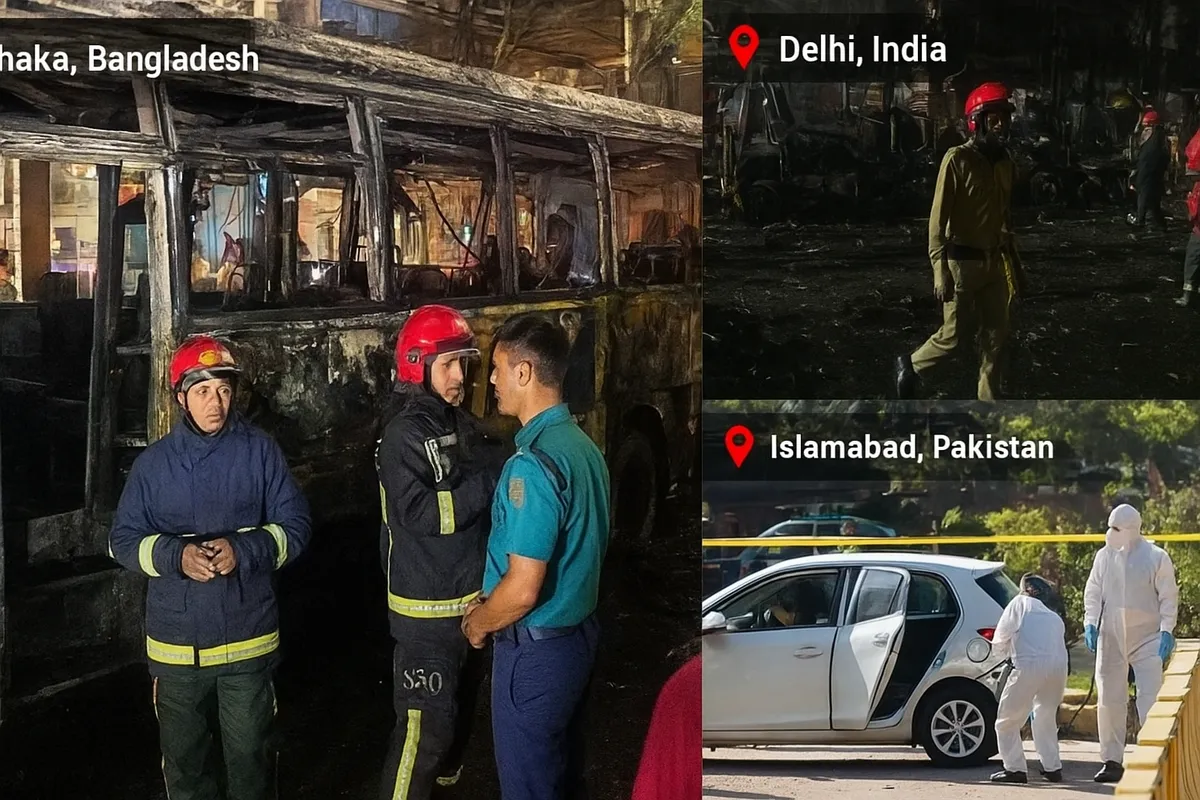
A wave of deadly explosions and arson attacks has swept across South Asia over the past two days, leaving dozens dead and many injured in Bangladesh, India, and Pakistan. The coordinated nature and timing of these violent incidents have raised deep concerns about regional security and the possibility of cross-border militant coordination.
Multiple Blasts Across Dhaka: Security Tightened Nationwide
Dhaka, the capital of Bangladesh, turned into a city of fear on Monday (November 10) as at least 11 separate explosions occurred throughout the day. The blasts, primarily crude “cocktail” bombs, were reported in several busy areas including Motijheel, Farmgate, Mirpur, and Gulistan. In addition, three passenger buses were set on fire in different parts of the city.
Although no casualties were reported, panic gripped the population as shopkeepers closed early and public transport came to a standstill. According to senior police officials, the incidents may have been politically motivated. Tensions have been running high following the announcement of the verdict date in a case against former Prime Minister Sheikh Hasina by the International Crimes Tribunal.
In response, the Police Headquarters issued directives to all metropolitan and district units to intensify patrols, intelligence operations, and surveillance until November 13. Security has also been strengthened around metro stations, airports, and key government installations.
Deadly Bomb Attack in Delhi Kills 13
Just hours later, a devastating explosion shook India’s capital, New Delhi. On Monday evening (November 10), a white Hyundai i20 car exploded near the historic Red Fort Metro Station, killing at least 13 people and injuring 24 others.
Emergency services rushed to the scene as flames engulfed nearby vehicles. The National Investigation Agency (NIA) and National Security Guard (NSG) have jointly launched a probe, initially suspecting a coordinated terrorist attack.
Authorities have since declared a high alert across major Indian cities including Mumbai, Jaipur, Uttar Pradesh, and Uttarakhand. Security at railway stations, metro terminals, places of worship, and government offices has been tightened.
Indian media outlets have speculated about possible links to international terrorist groups, though no organization has yet claimed responsibility. “We are examining every lead with an open mind,” said a senior Delhi Police officer. “This was a well-planned operation, and the target appears to have been symbolic as well as strategic.”
Islamabad Court Bombing Leaves 12 Dead
A day after the Delhi attack, on Tuesday (November 11), another major explosion struck Pakistan’s capital, Islamabad. The blast occurred outside the District and Sessions Court complex, killing at least 12 people and injuring more than 20.
According to Pakistan’s Interior Minister Mohsin Naqvi, preliminary findings suggest it was a suicide bombing. The suspect reportedly attempted to enter the courthouse but detonated explosives near a police vehicle after being stopped at the security checkpoint.
Police cordoned off the area and launched a full-scale investigation. “We are awaiting forensic results to determine the exact nature of the explosives used,” said an Islamabad police spokesperson. The government has declared a nationwide state of high alert, deploying additional forces in major cities including Karachi, Lahore, and Peshawar.
Regional Security Under Renewed Threat
The near-simultaneous explosions across Bangladesh, India, and Pakistan have reignited fears of a new wave of militancy in South Asia. Analysts warn that political instability, socio-economic stress, and rising religious extremism are once again converging to create a volatile security environment.
A Dhaka-based security analyst commented, “South Asia’s combination of political polarization, poverty, and extremist ideology creates fertile ground for terrorism. When such incidents occur in one country, the ripple effects can easily cross borders.”
Experts also note that the timing—amid political transitions and judicial tensions in multiple nations—suggests that both domestic groups and transnational networks could be exploiting the instability.
Calls for Cooperation and Stability
The United Nations and other international organizations have called for enhanced regional cooperation to counter terrorism and violent extremism. They emphasized the importance of intelligence sharing, border monitoring, and joint operations to prevent cross-border arms trafficking and militant infiltration.
In Dhaka, Bangladesh’s Foreign Affairs Adviser Towhid Hossain reiterated the country’s “zero tolerance” policy toward terrorism. “Bangladesh firmly believes that collective security is the key to regional peace,” he said at a press briefing. “We expect our neighbors to engage in coordinated efforts to dismantle these networks before they escalate further.”
A Region on the Brink
The recent string of explosions highlights how fragile the security situation in South Asia remains. Experts warn that without political tolerance, mutual trust, and genuine regional cooperation, the subcontinent may once again descend into cycles of violence and instability.
As fear grips the streets of Dhaka, Delhi, and Islamabad, one message rings clear: the fight against terror can no longer be fought in isolation. The safety of one nation depends on the vigilance and unity of all.