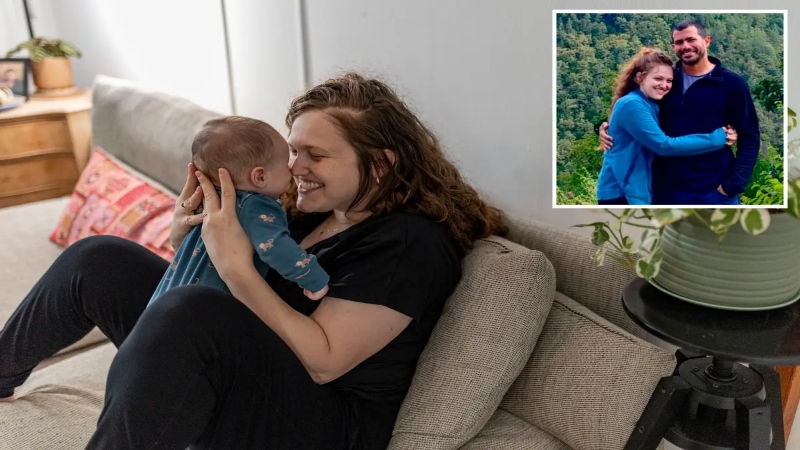
Israeli Doctor Becomes a Mother Using the Sperm of Her Deceased Fiancé
An extraordinary medical breakthrough unfolds amid the Israel–Gaza war
In the midst of the Israel–Gaza war, an astonishing event has captured global attention—an Israeli pediatrician has become a mother using the sperm of her deceased fiancé, retrieved just minutes after his death. The story has sparked intense discussions worldwide on science, ethics, love, and resilience.
The extraordinary journey began when Captain Netanel Silberg was killed during a military operation in Gaza. His fiancée, Israeli pediatric specialist Dr. Hadas Levy, received the devastating news while still working at her hospital. There was barely time to process her grief. She knew that if she wanted any chance of preserving their shared dream of having a family, she had to act immediately.
A Race Against Time: Sperm Retrieval Within 20 Minutes
Dr. Levy made an urgent request to initiate Postmortem Sperm Retrieval (PSR)—a procedure in which sperm is collected from a deceased individual shortly after death. Timing was critical; sperm viability declines rapidly in an oxygen-deprived environment.
She arrived at Jerusalem’s Hadassah Hospital, where a team of specialists began the delicate and time-sensitive procedure. What followed was nearly 10 hours of painstaking laboratory work.
Despite the odds, the team managed to recover only nine viable sperm cells—an exceptionally small number. Doctors were unsure whether such a limited collection could lead to a successful pregnancy through IVF. Scientific uncertainty was only part of the challenge; a larger debate had begun to unfold.
Legal and Ethical Complexities
Because Netanel and Dr. Levy were not yet married, questions arose about whether she legally had the right to use his genetic material. Many countries impose strict regulations on postmortem reproduction due to ethical concerns regarding consent, inheritance rights, and the moral status of creating a child from a deceased person.
Israel itself has long wrestled with these dilemmas. Yet Dr. Levy persisted, emphasizing that she and Netanel had been planning a future and family together.
“This child is my act of resistance—our answer to the destruction around us,” she said. “He carries forward our lineage and our love.”
A Miracle: Pregnancy After 18 Months
After navigating legal, medical, and ethical hurdles, Dr. Levy proceeded with IVF. In October 2024—around a year and a half after Netanel’s death—she conceived. Doctors and scientists described the successful fertilization using just nine sperm cells as “nothing short of miraculous.”
To Dr. Levy, the pregnancy represented hope amid devastation. “It feels like something out of science fiction,” she said. “But it is real, and it is ours.”
Earlier this year, she gave birth to a healthy baby boy, hailed as a “symbol of life born out of tragedy.”
How Postmortem Sperm Retrieval Works
PSR was first developed in the 1980s. The first child conceived through this method was born in 1999. The procedure generally involves:
- Retrieving sperm within 24–36 hours of death, sometimes longer if the deceased was brain-dead but physiologically supported.
- Extracting sperm through epididymal aspiration, where a needle is inserted through the skin to reach the epididymis.
- Freezing and preserving the sperm in liquid nitrogen, similar to standard fertility clinics.
- Later using IVF to fertilize an egg and implant the embryo.
Although not technically difficult, the practice remains ethically charged. Many countries either ban or heavily regulate PSR due to varying cultural, religious, and legal concerns.
A Story the World Cannot Ignore
Dr. Levy’s story resonates far beyond the borders of Israel. It raises profound questions:
- Who has the right to parenthood after a partner dies?
- How should science balance innovation and ethics?
- What does love mean in the age of advanced reproductive technology?
For Dr. Levy, the answer is clear. Her son is a testament to the life and future she and Netanel dreamed of—one that even death could not halt.