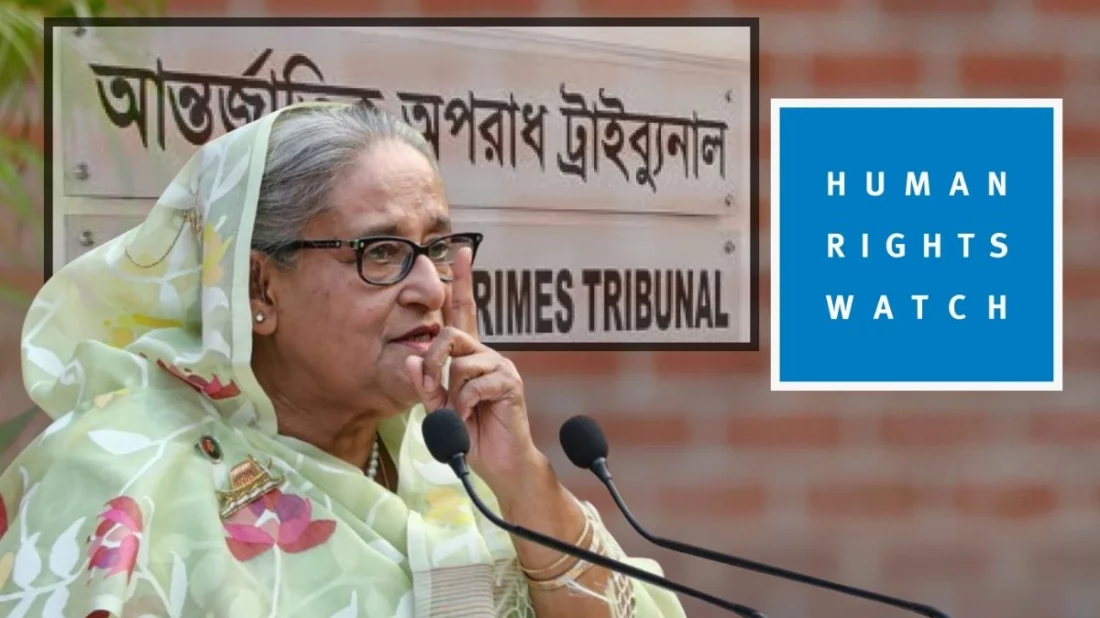
 Bangladesh’s International Crimes Tribunal (ICT) recently delivered a historic and highly debated verdict: the death sentence for ousted former Prime Minister Sheikh Hasina and former Home Minister Asaduzzaman Khan Kamal for crimes against humanity committed during the student-led July 2024 uprising. Following the judgment, the global human rights organization Human Rights Watch (HRW) released a statement expressing concerns about procedural flaws and possible violations of international fair-trial standards.
However, the reaction inside Bangladesh has been markedly different. A wave of public questions has emerged:
Is HRW’s concern rooted in genuine human rights principles, or is it influenced by political bias and selective attention—particularly considering its past silence during the long years of state-sponsored abuses under the Hasina administration?
Meenakshi Ganguly’s Statement and the Allegation of Bias
HRW’s Deputy Director for Asia, Meenakshi Ganguly, stated that the trial “did not meet international standards of justice,” pointing to the absence of the accused, the alleged denial of their preferred legal counsel, and restricted cross-examination opportunities.
But the central question many Bangladeshis are now raising is this:
Where was HRW—and where was Meenakshi Ganguly—during the years when enforced disappearances, torture, extrajudicial killings, and politically motivated trials were rampant under the Awami League government?
Between 2010 and 2023, Bangladesh witnessed:
- Hundreds of alleged enforced disappearances
- Dozens of extrajudicial killings
- The infamous ICT Skype scandal, where leaked conversations revealed political interference in war-crimes trials
- Widespread allegations of fabricated witnesses, coached testimonies, and judicial misconduct
- Systematic targeting of opposition leaders, journalists, and activists
Yet during this entire period, critics argue, HRW’s voice remained either muted or sporadic, never demanding the kind of thorough investigations it is now calling for.
This silence has strengthened a widespread suspicion:
“Is HRW’s sudden activism influenced by the Indian nationality of its Asia Director and India’s known political alignment with the former Hasina government?”
Many Bangladeshis believe that Indian human rights lobbies remained notably quiet during Hasina’s era of repression, creating a perception that HRW’s present concerns may be calibrated rather than impartial.
HRW’s Claims vs. Bangladesh’s Reality: Which One Holds?
HRW raised several key concerns in its statement:
- The trial was conducted in absentia
- The defendants allegedly lacked their chosen lawyers
- The scope of cross-examination was limited
- The imposition of the death penalty does not align with international human rights norms
But these concerns have prompted a counter-question from the general public:
Where was HRW when similar allegations plagued the ICT between 2010 and 2023?
At that time:
- Trials were rushed
- Judges were accused of receiving political instructions
- Defense witnesses were reportedly obstructed
- Evidence was allegedly manipulated
- The entire tribunal was engulfed in controversy
Yet HRW did not demand a global investigation or raise sustained alarm.
To the victims of the July–August 2024 uprising—families who lost their children, spouses, and loved ones—HRW’s sudden intervention now appears selective, even hypocritical.
The July–August 2024 Uprising: A Brief, Bloody History
The three-week-long student-led uprising of July–August 2024 remains one of the darkest chapters in Bangladesh’s recent political history.
According to UN estimates:
- Around 1,400 people were killed
- Most were shot dead by security forces
- Victims included schoolchildren, college students, young workers, and even bystanders
- Thousands more were injured or arbitrarily detained
In the ICT trial:
- 54 witnesses testified
- Half of them were subject-matter experts
- The rest were either direct victims or family members
- A voice recording—presented as evidence—featured Hasina allegedly authorizing security forces to use lethal weapons and aerial support, including drones and helicopters
Judges stated that the prosecution’s evidence “substantially strengthened the structural chain of command linking the accused to the atrocities.”
Key Findings of the 453-Page Verdict
The tribunal’s comprehensive verdict highlighted:
- Reliance on Article 7 of the Rome Statute
- Command responsibility directly attributed to Sheikh Hasina
- Authorization of lethal force, drones, and aerial surveillance
- Failure to prevent three major mass killings despite prior intelligence
- Victim testimonies forming the backbone of the prosecution
- Hasina’s own interviews, where she acknowledged “leadership responsibility,” being cited as corroborative evidence
This is the first time in Bangladesh’s history that state leaders were held accountable for mass atrocities committed during a contemporary political crisis.
Legal Reforms by the Interim Government: Praise and Criticism
The interim administration led by Nobel laureate Dr. Muhammad Yunus amended the International Crimes Act by:
- Explicitly criminalizing enforced disappearances
- Strengthening command responsibility clauses
- Aligning domestic law more closely with the Rome Statute
Human rights organizations largely welcomed these reforms.
However, HRW expressed concern over a new provision allowing the dissolution of political parties found to be involved in mass atrocities. Critics say HRW selectively highlights provisions that could disfavor specific political actors while overlooking long-needed reforms addressing past abuses.
Extradition Requests to India: A New Diplomatic Flashpoint
Bangladesh has formally requested India to extradite Hasina and Kamal for the enforcement of the verdict.
HRW responded by urging India to ensure:
- No risk of execution
- No risk of unfair trial
But this raises further criticism inside Bangladesh:
Is HRW questioning the integrity of Bangladesh’s judiciary, or is it indirectly shielding individuals closely associated with India’s geopolitical interests?
The Core Issue: Is Justice One-Sided, or Do Victims Also Deserve a Voice?
The anger among the Bangladeshi public toward HRW stems from one undeniable truth:
For decades, the voices of victims—families of the disappeared, the tortured, the unlawfully detained—remained unheard. HRW and other global bodies did not meaningfully amplify their cries for justice.
But now, when accountability mechanisms have finally begun functioning, HRW has suddenly become hyperactive.
As Meenakshi Ganguly stated:
“Ensuring justice means protecting the rights of the accused.”
Bangladeshis counter with a simple but powerful question:
“Where were you when the rights of victims were violated year after year?”
Why was the global human rights community quiet then, only to become vocal now?
In a country finally beginning to see the possibility of justice after long years of fear and repression, the sudden revival of selective human rights rhetoric feels—to many—not impartial, but deeply political.