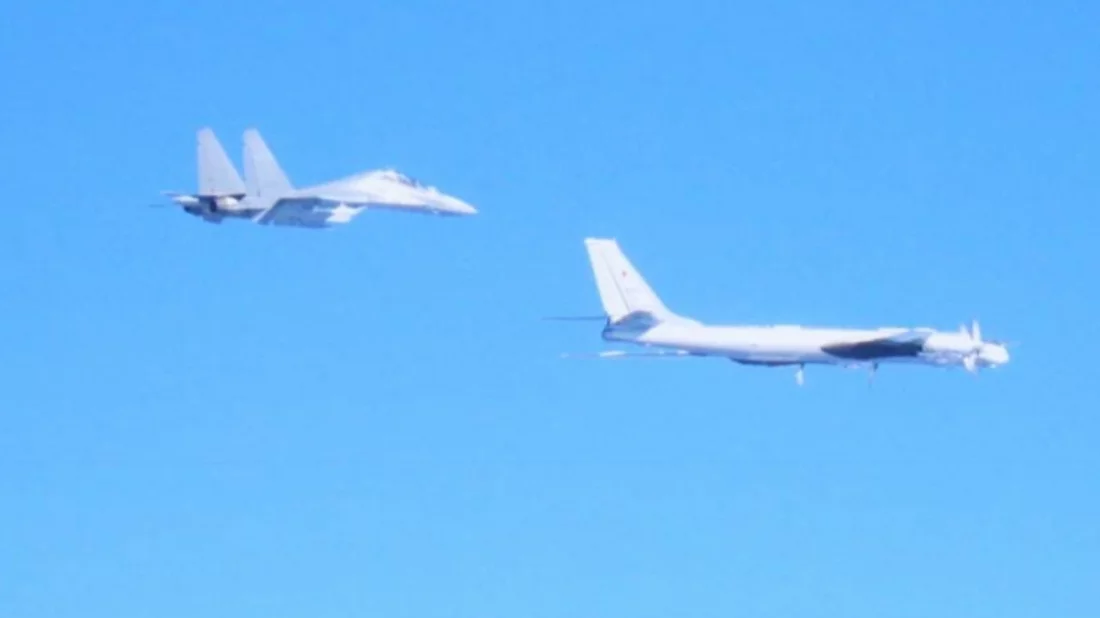
Japan has raised fresh security concerns after Russian and Chinese strategic bombers conducted a long-range joint patrol around its airspace—an operation that comes amid heightened tensions between Tokyo and Beijing. In response, Japan scrambled fighter jets to monitor the formation and assess potential risks, officials said late on Tuesday (9 December).
According to Japan’s Ministry of Defense, two Russian Tu-95 strategic bombers—aircraft capable of carrying nuclear weapons—flew from the Sea of Japan toward the East China Sea. There, the Russian bombers linked up with two Chinese H-6 bombers, and the combined formation proceeded to carry out a long-distance patrol over the Pacific Ocean. The maneuver was part of a broader Russia-China military cooperation program that has intensified in recent years.
The ministry added that the mission later expanded when four Chinese J-16 fighter jets joined the bomber group. These fighters flew back and forth between Okinawa and Miyako Island, traversing the Miyako Strait, an internationally recognized waterway that serves as a critical passage between the East China Sea and the western Pacific. The strait is often used by Chinese military aircraft and ships to project power into the Pacific—an activity that Japan views with increasing unease.
Simultaneously, Japan detected additional Russian Air Force activity in the Sea of Japan. Radar identified an A-50 early-warning aircraft and two Su-30 fighter jets operating in the area, further underscoring the scale of the day’s military movements.
On Wednesday (10 December), Japanese Defense Minister Shinjiro Koizumi reacted strongly in a statement posted on X (formerly Twitter). He wrote that the joint air patrol was a “clear demonstration of force directed against our country” and described the incident as a matter of “serious concern for Japan’s national security.” Koizumi stated that Japanese fighter jets “strictly adhered to all air-defense protocols and identification procedures” throughout the encounter.
Russian media, citing the Ministry of Defense in Moscow, reported that the joint patrol lasted for nearly eight hours—one of the longest coordinated flights conducted near Japanese territory. South Korea also issued a statement on Tuesday, confirming that seven Russian aircraft and two Chinese military planes had entered its Air Defense Identification Zone (KADIZ), prompting Seoul to take its own monitoring measures.
The latest display of military coordination between China and Russia comes at a sensitive diplomatic moment. Just last month, Japanese Prime Minister Sanae Takaichi warned that Tokyo could respond if Chinese military action against Taiwan jeopardized Japan’s security. China has dismissed Japan’s growing involvement in Taiwan-related issues, but the joint air operations with Russia reflect Beijing’s willingness to signal military strength in the region.
In recent years, China and Russia have expanded defense cooperation through joint drills, naval exercises, and coordinated bomber patrols—an alignment that poses strategic challenges for U.S. allies in East Asia. Japan, which relies on its alliance with Washington for deterrence, has been increasing defense spending and revising its security posture in response to what it views as an increasingly hostile regional environment.
Source: Reuters