The shadow of Hindutva is steadily descending over Kashmir. Recent developments—such as intensified surveillance of mosques and madrasas, and the decision to shut down a medical college largely attended by Muslim students—are clear indicators of a deeper and more troubling reality.
What is unfolding in Kashmir is not an isolated phenomenon. It is part of a long-running, systematic process targeting Muslims across India, where institutionalized Islamophobia is being used to marginalize and gradually exclude the country’s largest minority community. Over the past decade, the influence of Hindutva ideology on India’s politics and society has become so pervasive that it now shapes the country’s social and political structures.
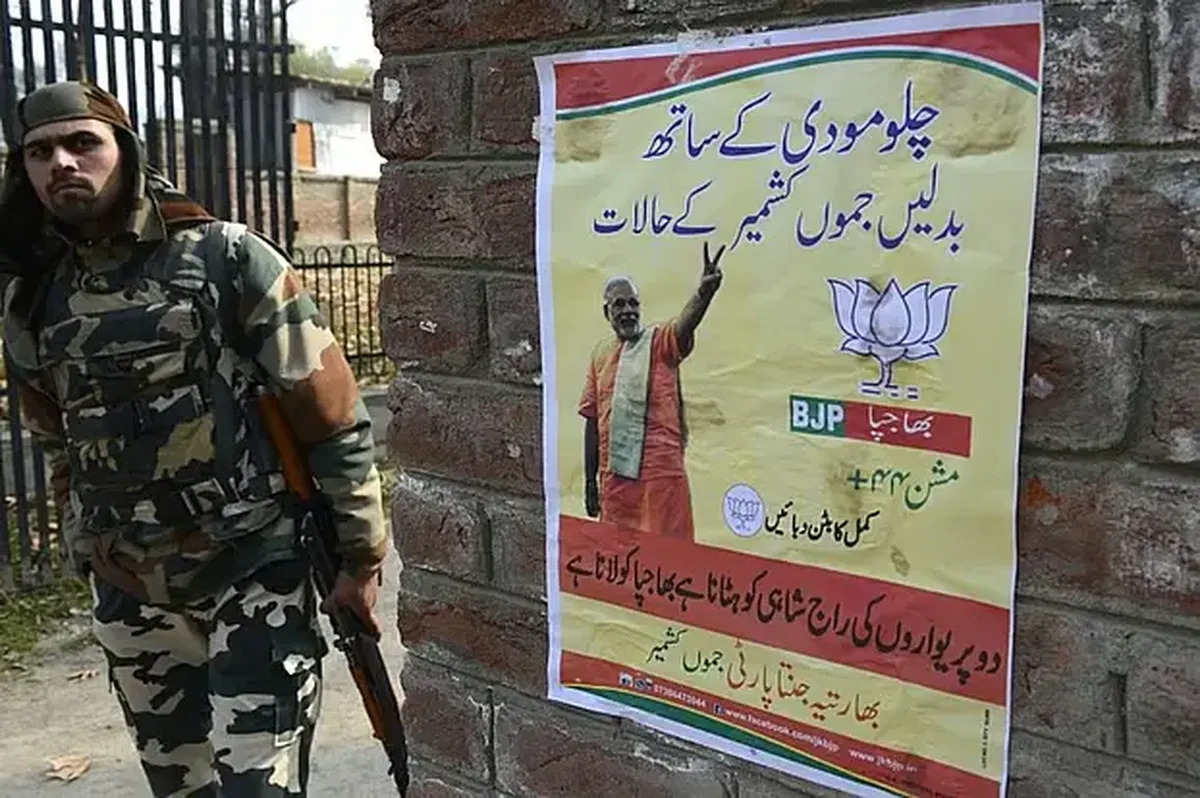
Efforts to “saffronize” India’s constitutionally secular state are not new. However, since the Bharatiya Janata Party (BJP) consolidated state power and gained significant influence over large sections of the media, this process has accelerated at an unprecedented pace. Saffronization—or Hinduisation—has never been detached from Islamophobia; it is inseparably linked to a political project aimed at the marginalization of Muslims.
It has been made increasingly clear that peaceful coexistence and the protection of minority rights are no longer state priorities. Violence in the name of cow protection, conspiracy theories such as “love jihad” and “land jihad,” the demolition of mosques, public lynchings, and the use of bulldozers in impoverished Muslim neighborhoods all point to a single conclusion: Muslims are the primary targets of Hindutva’s politics of hate.
Today, the harshest impact of this project is being felt by Kashmiri Muslims. Although Muslims form a majority in Kashmir, a politics of fear, suspicion, and exclusion is being used to recast them as a suspect and marginalized population—much like Muslims elsewhere in India. Recently, Jammu and Kashmir Police launched intrusive operations across the valley targeting mosques and madrasas. Multi-page forms have been distributed demanding personal and financial information from imams, religious teachers, and mosque committee members. Authorities claim these measures are part of counterterrorism efforts. Yet for many Kashmiris, they appear less about security and more about collective suspicion and mass surveillance.
This Hindutva-driven project is advancing slowly but ruthlessly. On one hand, it is capturing institutions; on the other, it is shaping public consciousness itself. Religious leaders, civil society organizations, and elected representatives have strongly condemned these actions, arguing that they violate constitutional guarantees of religious freedom and personal privacy. Subjecting places of worship to surveillance sends a powerful message: that faith and religious spaces of an entire community are viewed with suspicion by the state.
The closure of the Shri Mata Vaishno Devi Institute of Medical Excellence in Jammu reveals another deeply alarming dimension of exclusion. Of the 50 students admitted to its first MBBS batch, 42 were Muslims—all selected purely on merit through India’s national entrance examination. Soon after their admission, far-right groups launched protests, claiming Muslims had no right to benefit from an institution associated with a Hindu pilgrimage site. Shortly thereafter, the National Medical Commission withdrew the college’s recognition, citing infrastructural deficiencies.
Viewed together, these incidents demonstrate how Muslim lives and achievements are increasingly treated as a “problem” to be managed. In Kashmir, this reality is even more severe, as the region is already subjected to frequent search operations, checkpoints, and constant surveillance.
In November 2025, United Nations human rights experts issued grave warnings regarding India’s counterterrorism operations in Jammu and Kashmir. Following an attack in Pahalgam in April 2025, nearly 2,800 people were detained, including journalists and human rights defenders. Numerous reports documented arbitrary arrests, torture, prolonged detention without trial, enforced communication blackouts, demolition of homes, and harassment of Kashmiri students across India.
Kashmir is increasingly becoming a mirror of broader Hindutva trends across the country. According to a report by the Centre for the Study of Society and Secularism, communal violence increased by 84 percent in 2024, with Muslims accounting for a disproportionate share of the victims. Of the 59 recorded incidents of communal violence that year, 49 occurred in BJP-ruled states. Between 2009 and 2019, nearly 90 percent of religion-based hate crimes took place after the BJP came to power in 2014.
The same pattern is evident in hate speech. Data from India Hate Lab shows that in 2025 alone, more than 1,300 incidents of hate speech were recorded—most of them in BJP-ruled states and primarily targeting Muslims and Christians. Vigilante violence in the name of cow protection, bulldozer justice, and discriminatory laws related to citizenship and religious conversion have normalized collective punishment and a culture of impunity.
What is happening in Kashmir is the logical outcome of a Hindutva project rooted in fear and exclusion. A population already living under intense surveillance is being pushed even further to the margins—socially, politically, and institutionally—on the basis of religion alone. In this context, the future of Muslims in India appears increasingly bleak.
The Hindutva project continues to advance—slowly, but relentlessly. It captures institutions while reshaping minds. Ultimately, however, the final choice rests with the people of India: whether they will hand over the world’s largest democracy to forces of hate and religious extremism, transforming it into the fear-driven state envisioned by Savarkar, or defend the secular republic imagined by Gandhi and Nehru.
At this moment, there is little reason to feel hopeful about which path the country is choosing.