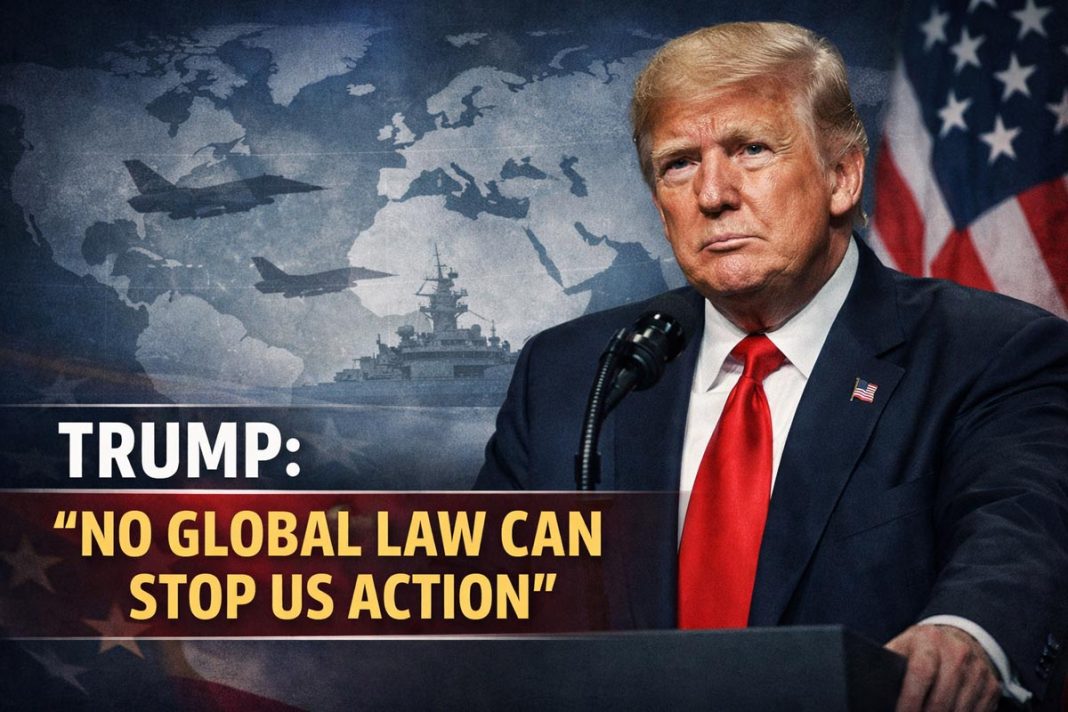
U.S. President Donald Trump has once again stirred global controversy by openly describing himself as a “dictator,” going even further to suggest that such leadership is sometimes necessary—and that he has already demonstrated it in practice.
Speaking to journalists after his address at the World Economic Forum in Davos, Switzerland, Trump said, “I am a dictator. Sometimes you need a dictator.” His remark, coupled with provocative statements on Greenland, Canada, and Europe, has reignited international debate over his political mindset and leadership style.
Trump appeared pleased with the reception of his Davos speech, telling reporters, “We gave a great speech, got an incredible response. I can’t believe it—everyone gave positive reviews.” He then added, “Usually they say—he’s a terrible dictator-type person. Well, I am a dictator.”
However, Trump went a step further, arguing that authoritarian leadership can be justified. “But sometimes a dictator is needed. This isn’t about being conservative or liberal—it’s just common sense,” he claimed.
This was not the first time Trump compared himself to a dictator. In August last year, while signing orders related to deploying the National Guard to curb crime and immigration, and directing legal action against flag-burning incidents in Washington, he suggested that Americans might actually want a dictator. At the time, he complained that he was not receiving enough credit for his tough stance on crime and immigration.
“They say we don’t need him. Freedom, freedom. He’s a dictator,” Trump recalled. “A lot of people are saying—maybe we do like a dictator.”
Yet, in a familiar contradiction, Trump later insisted, “I don’t like dictators. I’m not a dictator. I’m a person of common sense and a smart individual.”
Ahead of the 2024 election, Trump also told Fox News host Sean Hannity that he would act like a dictator—but only on his first day in office, to push through key decisions.
Trump’s admiration for strongman leaders is well documented. He has repeatedly praised Russian President Vladimir Putin as “smart,” “very smart,” and a “strong leader.” Chinese President Xi Jinping has been described by Trump as “powerful,” “highly respected,” and even compared to a central Hollywood character—claiming no actor could play such a role convincingly.
He has also referred to North Korean leader Kim Jong Un as “tough” and “very smart,” and famously remarked in 2018 that the two leaders had “fallen in love.”
Taken together, Trump’s words and actions continue to blur the line between rhetorical bravado and an unapologetic embrace of authoritarianism—raising questions not just about what he says, but what he has already proven through his political conduct.
Source: NDTV