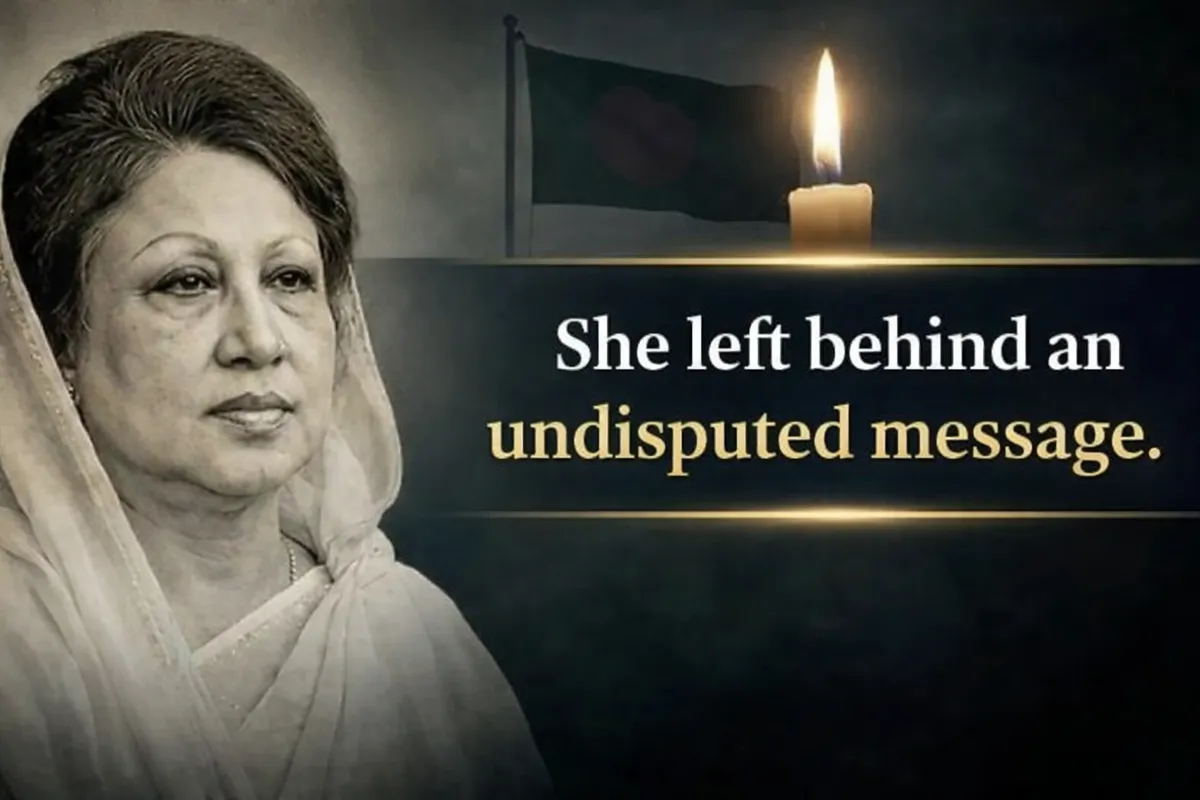
Bangladesh is passing through a moment of profound national mourning. With the death of BNP Chairperson and former Prime Minister Begum Khaleda Zia on Tuesday morning (30 December), a long and defining chapter of the country’s political history has come to an end. She breathed her last shortly after the Fajr prayer at 6:00 am. Her passing is not merely the loss of a political leader—it is a collective bereavement for the nation at a time of deep political uncertainty and democratic crisis. In this critical hour, the people have lost a guardian, and the Bangladesh Nationalist Party has lost its political mother.
Begum Khaleda Zia was far more than a party chief. She was a symbol of resilience, courage, and resistance. Despite suffering for years from severe health complications—including heart disease, diabetes, arthritis, liver cirrhosis, and kidney failure—she remained the unifying moral force of her party until her final days. Her prolonged illness and eventual death have left BNP leaders and activists in deep grief, while ordinary citizens across the country mourn a leader who stood as a counterweight to authoritarianism.
History remembers certain individuals not just by their offices, but by the eras they define. Khaleda Zia was one such figure. As the first female Prime Minister of Bangladesh and the second elected female head of government in the Muslim world, she shattered entrenched barriers in a conservative political culture. Her rise symbolized the empowerment of women in national leadership and redefined political participation in South Asia.
Her role in restoring parliamentary democracy in 1991 remains one of the most significant milestones in Bangladesh’s post-independence history. Under her leadership, democratic institutions were revived, press freedom expanded, and multiparty politics regained legitimacy. These achievements were not merely administrative successes; they represented the collective aspirations of a nation emerging from years of authoritarian rule.
Khaleda Zia’s political record is also marked by an unparalleled electoral legacy. She never lost a parliamentary election. From 1991 to 2001, she was elected from five different constituencies, and even in the heavily disputed 2008 election, she won all three seats she contested. This consistent public mandate reflected not only popularity but deep-rooted public trust.
Yet the final chapter of her life was painfully tragic. Years of imprisonment, denial of adequate medical care, and restrictions on seeking advanced treatment abroad exposed a harsh and unforgiving political environment. The manner in which a former prime minister spent her final years will remain a troubling question for Bangladesh’s conscience and its historical judgment.
Her political journey began under extraordinary circumstances. After the assassination of President Ziaur Rahman in 1981, she stepped into politics not by ambition, but by necessity. From a homemaker to the leader of a major political party, her ascent was driven by resolve, sacrifice, and political acumen. Her leadership during anti-autocracy movements and her uncompromising stance on electoral rights earned her the affection of party workers, who came to see her not just as a leader, but as a maternal figure.
Today, as Bangladesh faces serious questions about electoral legitimacy, shrinking democratic space, and political repression, her absence is felt more acutely than ever. For BNP, the challenge ahead is historic: to carry forward her legacy with unity, restraint, and democratic commitment. Her politics emphasized perseverance over vengeance, and democracy over expediency.
The state, too, bears responsibility at this moment. Beyond political divisions, honoring a former prime minister with dignity is not merely ceremonial—it is a reflection of national maturity. How the nation responds to her passing will be remembered by history, which judges not by power, but by principle.
At this critical juncture in Bangladesh’s journey, the departure of Begum Khaleda Zia reminds us that politics is ultimately about safeguarding the hopes of the people. She was a pillar of that hope. Though she is no longer with us, her struggle, leadership, and vision for a democratic Bangladesh will remain permanently etched in the nation’s political memory.
Inna Lillahi wa Inna Ilaihi Raji’un.
May Allah grant eternal peace to Begum Khaleda Zia and give strength to her family, her party, and the grieving nation.