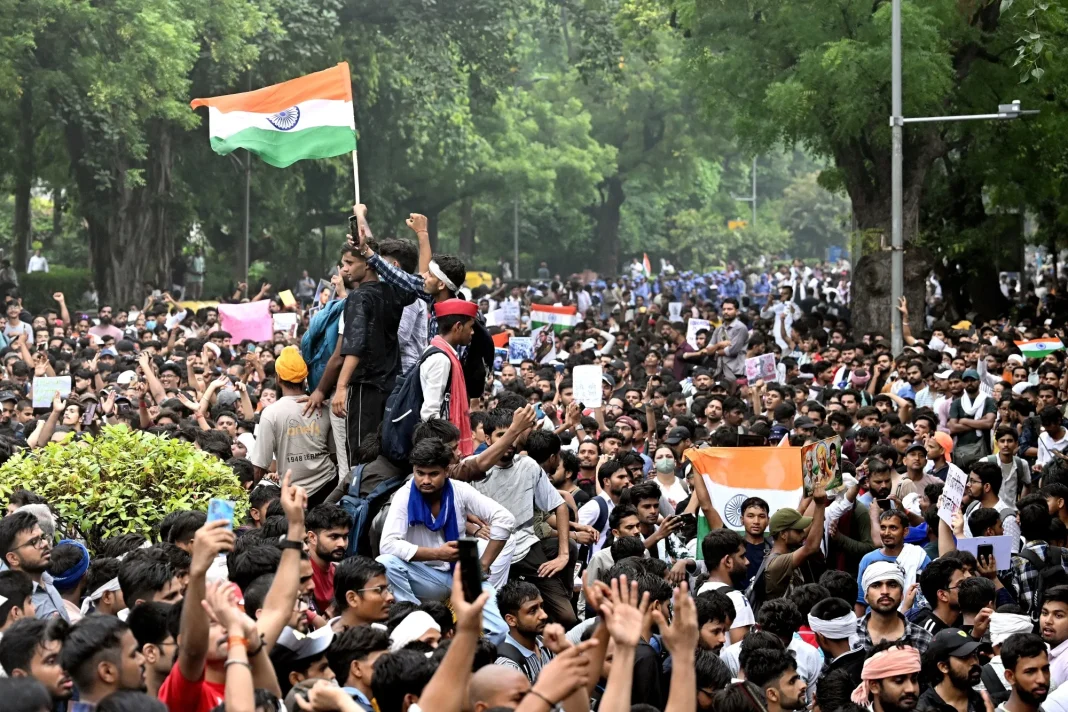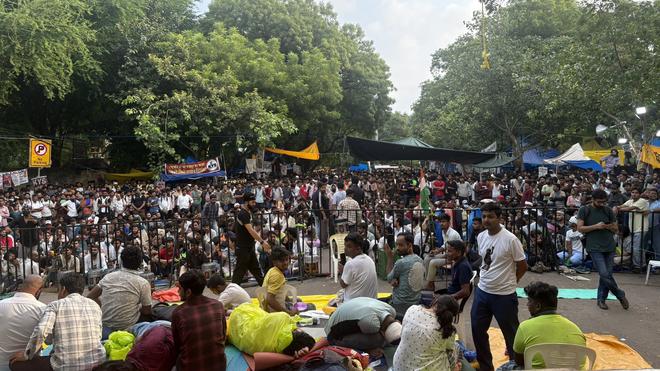
India, often described as the world’s largest democracy, is witnessing one of the most significant youth-led protest movements in recent years. The ongoing demonstrations led by the Cockroach Janta Party (CJP) began over alleged examination paper leaks and demands for education reform, but they have rapidly evolved into a broader expression of frustration over unemployment, governance, accountability, and democratic rights. While international media have devoted extensive attention to these events, many critics argue that large sections of India’s mainstream television media have provided comparatively limited coverage or framed the movement primarily through the lens of law and order rather than the protesters’ grievances.
The movement gained momentum after students and young professionals protested repeated allegations of examination irregularities and demanded the resignation of India’s Education Minister. Police action against demonstrators, including the use of barricades, batons, and detentions during marches toward Parliament, attracted widespread international attention and intensified public sympathy for the protesters. Despite these developments, many protesters and media observers contend that India’s major television news networks have not reflected the scale or substance of the demonstrations to the same extent as international outlets.
International organizations and global news agencies—including Reuters, the Associated Press, ABC News Australia, Al Jazeera, and The Guardian—have reported extensively on the protests. Their reports describe thousands of young Indians gathering in New Delhi and other cities, highlighting issues such as youth unemployment, examination scandals, and demands for institutional accountability. Several reports also note that the protests have expanded beyond education into a broader political challenge to Prime Minister Narendra Modi’s government. (
This contrast has reignited an old debate over the role of mainstream media in democratic societies. Media scholars have long discussed the concept of the “protest paradigm,” in which news organizations may emphasize disruption, conflict, or official statements while giving less attention to protesters’ underlying concerns. This framework has been used to analyze protest coverage in many countries, not only India, and serves as one possible lens through which some observers interpret current reporting patterns.
The concern is not entirely new. During earlier movements—including the farmers’ protests, the wrestlers’ protests, and demonstrations against the Citizenship Amendment Act (CAA)—critics similarly argued that some mainstream television channels either underreported the protests or framed them negatively, while independent and international media devoted more extensive coverage.
At the same time, it is important to recognize that the Indian media landscape is highly diverse. Some newspapers, digital outlets, and regional media have reported on the protests in detail, while others have focused on different aspects of the story. Likewise, government officials and supporters argue that law enforcement actions were necessary to maintain public order and that reforms to address examination irregularities are underway. Prime Minister Modi has publicly promised stronger action against corruption in examination systems, although CJP leaders have said these commitments do not fully address their demands.
The demonstrations have also highlighted the growing importance of social media. Platforms such as Instagram and X have enabled protesters to bypass traditional news channels and communicate directly with millions of people. This digital strategy has helped transform what began as a student movement into a nationwide political conversation, particularly among India’s younger generation.
For any democracy, the strength of public discourse depends not only on the right to protest but also on the public’s access to accurate, diverse, and independent reporting. When major public events receive markedly different levels of attention across media ecosystems, questions naturally arise about editorial priorities, media independence, and the ability of citizens to make informed judgments.
The CJP protests therefore represent more than a dispute over examination reforms. They have become a test of democratic institutions, freedom of expression, and the relationship between citizens, government, and the media. Whether the movement ultimately achieves its objectives remains uncertain, but it has already demonstrated that in the digital age, stories that struggle to find space on traditional television can still resonate across social media and international news platforms.
A healthy democracy is strengthened when competing viewpoints can be reported, debated, and scrutinized. The current moment in India underscores the continuing importance of an independent press, peaceful protest, and transparent public institutions—principles that remain central to democratic governance everywhere.