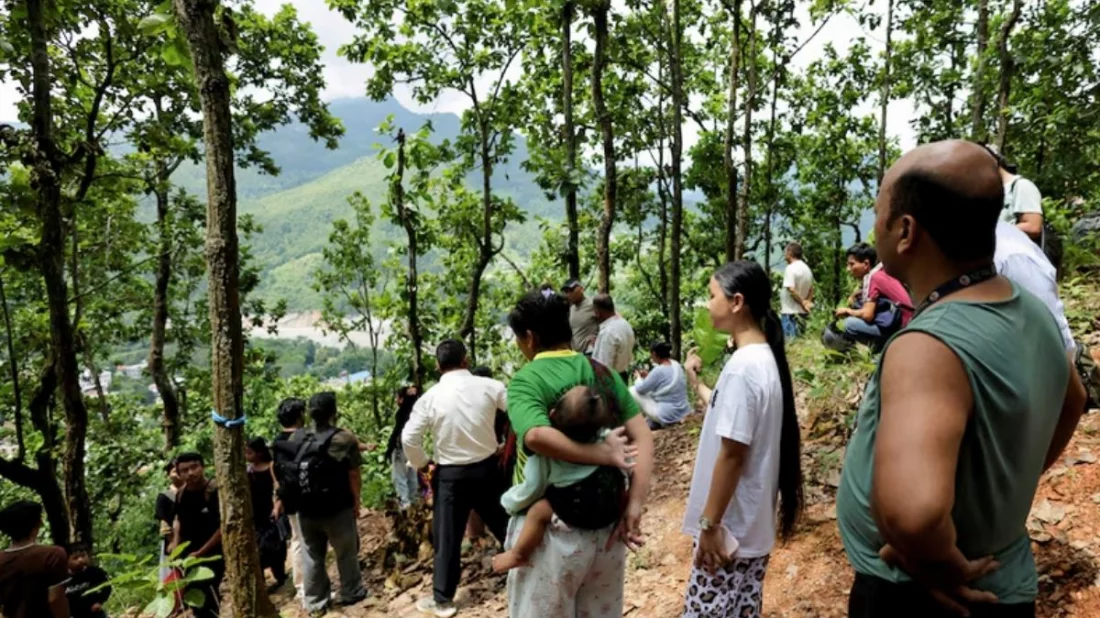
Fear of another catastrophic flood has gripped communities along the Nepal-China border after a newly formed barrier lake began overflowing, raising concerns that a sudden release of water could send another destructive surge downstream.
The latest threat emerged just days after a devastating glacial collapse and flash flood swept through parts of Nepal and China’s Tibet region, killing hundreds of people and leaving more than a thousand others missing.
Authorities in Nepal have issued fresh warnings to communities in low-lying and riverbank areas, particularly in Rasuwa district, urging residents to move to safer, higher ground. Rescue operations near the border were also temporarily suspended because of concerns that the unstable natural dam holding back the lake could fail.
Rescue Operations Suspended Amid Fresh Danger
Chinese authorities reportedly moved rescue personnel and vehicles to safer locations after water levels at the newly formed lake rose rapidly. Nepal’s security forces also temporarily halted rescue activities in areas considered vulnerable to another sudden flood.
The barrier lake was created when massive amounts of ice, rock, mud and other debris blocked a Himalayan river following the earlier glacial collapse. Such naturally dammed lakes can become extremely dangerous if water rises beyond the capacity of the debris barrier, potentially causing a sudden outburst flood.
Chinese experts have been closely monitoring the lake using drones and aerial surveys. The objective is to map the lake in three dimensions, assess the stability of the natural dam and determine how much water could be released if the barrier fails.
The situation remains fluid, with authorities on both sides of the border closely monitoring water levels and river conditions.
Death Toll and Missing Persons Continue to Rise
The disaster has already become one of Nepal’s most devastating recent natural catastrophes.
Nepalese authorities reported that at least 469 people had died by Friday, while hundreds more remained unaccounted for. Chinese authorities separately reported deaths and hundreds of missing people in Tibet. Later updates during Friday indicated that Nepal’s reported death toll was continuing to rise as rescue teams reached previously inaccessible areas. (Al Jazeera)
Across Nepal and Tibet, the number of missing people has exceeded 1,400, with foreign nationals accounting for a significant portion of those unaccounted for. In Tibet’s Gyirong County, Chinese state media reported hundreds missing, including approximately 260 foreign nationals. (Onmanorama)
The disaster has also affected international tourists and pilgrims travelling through the Himalayan region, including people heading toward Mount Kailash and Lake Mansarovar.
Nepal’s tourism authorities previously reported hundreds of tourists from dozens of countries out of contact after the floods. Indian, American, Australian, British and Canadian nationals are among those reported missing in Nepal. (Al Jazeera)
Roads, Bridges and Hydropower Facilities Destroyed
The initial flood unleashed a massive torrent of water, ice, mud and rocks through mountain valleys. The force of the water destroyed roads and bridges and severely damaged other critical infrastructure.
Several sections of roads connecting Nepal with Tibet have been washed away, making it extremely difficult for rescue teams to reach isolated communities.
The Trishuli and other interconnected river systems have also experienced dramatic rises in water levels. At one point, the Trishuli River reportedly rose several metres within a very short period, highlighting the extraordinary force of the floodwaters. (Al Jazeera)
Hydropower projects, bridges, culverts, homes, businesses and transport links have suffered extensive damage. Rescue operations have consequently become a race against time, with helicopters, soldiers, police, drones, sniffer dogs and heavy machinery being deployed where conditions permit.
Residents Move to Higher Ground
The renewed flood warning has created panic among residents living along rivers and in vulnerable valleys.
Officials in Nepal’s Rasuwa district have urged people living close to rivers to remain alert and move away from areas that could be inundated if the barrier lake suddenly releases its water.
Many residents have already begun leaving their homes and moving toward higher elevations, fearing that a second wave of flooding could arrive with little warning.
The danger is particularly serious because much of the affected region consists of steep Himalayan terrain, narrow river valleys and settlements located close to waterways.
China Faces Major Rescue Challenges in Tibet
Rescue operations in Tibet have also been severely hampered by landslides, debris and damaged transportation routes.
In Gyirong County, accumulated mud and debris have made it difficult for emergency personnel and equipment to reach some affected areas. Chinese authorities have deployed emergency teams while closely monitoring the barrier lake and surrounding terrain. (Al Jazeera)
Chinese authorities have also increased monitoring of glacier lakes, landslide zones and other potentially unstable areas following the disaster.
Trump Offers US Assistance
The disaster has drawn international attention, with US President Donald Trump offering Nepal assistance in dealing with the unprecedented catastrophe.
Trump said Washington was prepared to provide whatever help Nepal needed, as the scale of destruction became increasingly clear. The United States has also been closely monitoring the situation because dozens of American nationals were reported missing in connection with the disaster. (DD India)
Himalayan Disaster Raises Climate Concerns
The catastrophe has also renewed concerns about the growing vulnerability of the Himalayan region to climate-related hazards.
Scientists have warned that rising temperatures are accelerating glacier melt across the Himalayas, increasing the risks associated with unstable glacial lakes, landslides and sudden floods.
However, experts distinguish between the broader climate trend and the specific trigger of an individual disaster. In this case, authorities have described the initial event as an ice-and-rock avalanche or glacial collapse that sent enormous quantities of debris into the river system. (Al Jazeera)
With another barrier lake now threatening downstream communities, Nepal and China face a second critical challenge: preventing an already catastrophic disaster from becoming even worse.
For thousands of people living along the Himalayan river valleys, the immediate priority is survival. Authorities are urging residents to remain vigilant, avoid riverbanks and follow evacuation orders while specialists continue to assess the stability of the newly formed lake.