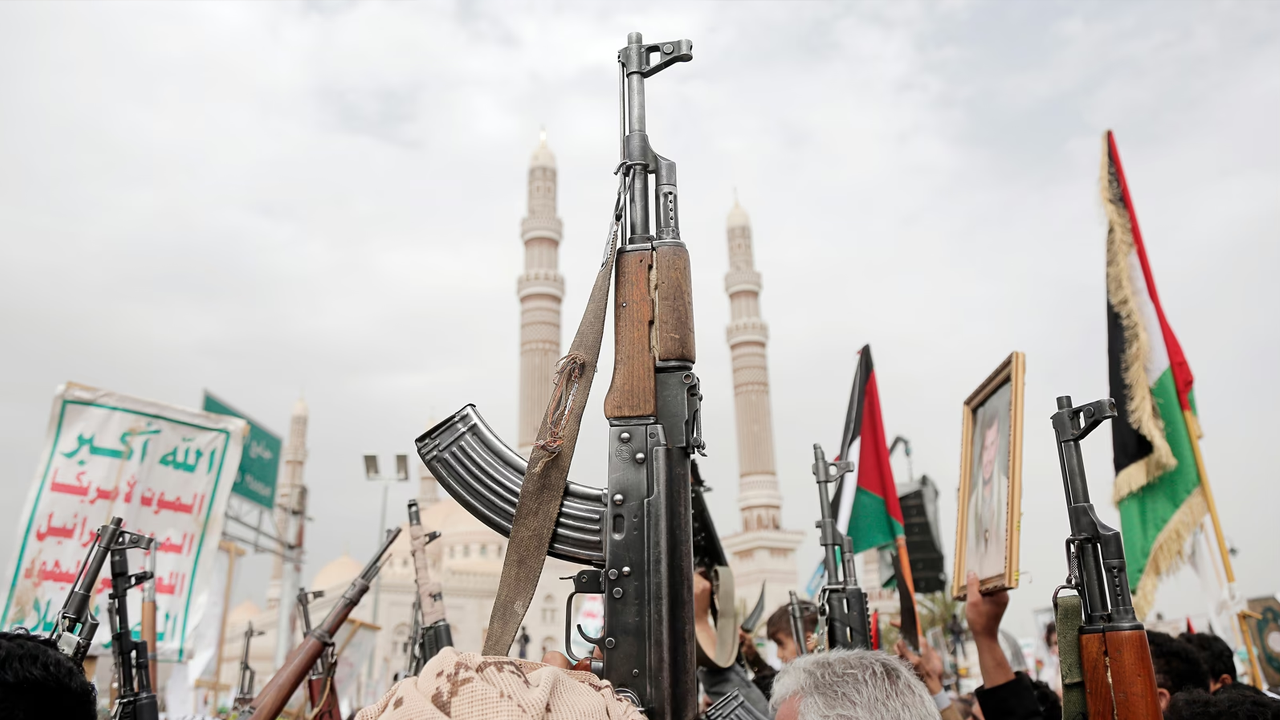
The security balance in the Gulf is undergoing a significant shift as Yemen’s Houthi movement intensifies its military campaign against Saudi Arabia. Recent attacks on Riyadh and Saudi energy infrastructure have demonstrated that the renewed Yemen conflict is no longer confined to the battlefield inside Yemen.
On September 19, Saudi authorities issued air-raid warnings across Riyadh after the Houthis claimed missile and drone attacks on what they described as “sensitive sites” in the Saudi capital. A large plume of smoke was later seen near King Khalid International Airport, where a fire broke out at a fuel-storage facility. Saudi-led coalition forces said a ballistic missile aimed at Riyadh had been intercepted and destroyed. No casualties were reported.
The Houthis also claimed that they had targeted facilities belonging to Saudi oil giant Aramco in Yanbu on the Red Sea coast. Saudi authorities said their air defences had thwarted attacks targeting Bisha, Taif, Farasan and Yanbu as well.
A New Challenge for Saudi Arabia
The latest escalation has raised questions about how far Saudi Arabia can rely on its traditional security partnerships.
The conflict between Saudi-backed Yemeni forces and the Houthis has intensified since July 2026. The renewed fighting represents the most serious escalation since the UN-brokered truce brought large-scale fighting to a halt in 2022.
The Houthis have increasingly sought to project their military capabilities beyond Yemen, particularly toward Saudi territory and the strategically important Red Sea corridor.
The September 19 attack was particularly significant because it brought the conflict directly to the Saudi capital. It was the first air-raid alert issued in Riyadh since the latest escalation began, according to reports.
Trump Faces Pressure from Riyadh
The escalation has also exposed tensions surrounding Washington’s role in the conflict.
According to reports, Saudi Crown Prince Mohammed bin Salman has pressed US President Donald Trump to take military action against the Houthis. Trump reportedly considered launching US strikes but ultimately decided against them, amid concerns that direct American intervention could widen the regional conflict.
The decision is significant because Saudi Arabia remains a major US security partner. However, Washington appears reluctant to open another major military front while the wider Middle East remains embroiled in conflict.
This has left Riyadh seeking ways to strengthen its own defences while maintaining diplomatic and military pressure on the Houthis.
The Red Sea Becomes Increasingly Important
The strategic importance of Yemen has increased because of the country’s location beside the Red Sea and the Bab al-Mandeb Strait.
Bab al-Mandeb is one of the world’s major maritime chokepoints, connecting the Red Sea with the Gulf of Aden and providing an important route for international trade and energy shipments.
The escalation has therefore created concerns beyond Saudi Arabia and Yemen. Any prolonged disruption of shipping through the Red Sea could increase transportation costs, affect energy markets and put further pressure on global supply chains.
The situation has become even more sensitive because of the wider disruption surrounding the Strait of Hormuz.
Secret US-Israel-Arab Military Discussions
At the same time, reports have emerged of secret military discussions involving Israel, the United States and several Arab countries.
According to Middle East Eye, military chiefs from Israel, Saudi Arabia, the United Arab Emirates, Bahrain, Kuwait, Qatar, Jordan and Egypt reportedly met in Germany for discussions concerning the Iran war and regional military cooperation.
The reported meeting illustrates the increasingly complex security environment facing Gulf states.
However, cooperation between Arab governments and Israel remains politically sensitive, particularly amid the continuing conflicts across the region.
Israel Offers Security Assistance
Israel has also reportedly offered military and intelligence assistance to Gulf states facing the Houthi threat.
However, regional analysts have questioned whether Saudi Arabia would want to replace its traditional dependence on Washington with dependence on an Israeli security framework.
The issue is particularly complicated because the Houthis are closely associated with Iran, while the wider Middle East is already experiencing an intense confrontation involving Iran, Israel and the United States.
Turkey and Pakistan Enter the Picture
Saudi Arabia has also been strengthening its security relationships beyond the United States.
Recent developments have raised the possibility of greater involvement by Turkey and Pakistan under Saudi security arrangements. Reuters reported on September 21 that the United Kingdom had agreed to provide defensive air-to-air refuelling support to Saudi Arabia following a formal request from Riyadh. London said the move was intended to help protect regional stability and vital routes, including the Strait of Hormuz.
These developments suggest that Saudi Arabia is seeking a broader network of security partnerships rather than relying on a single external power.
The Houthis Continue to Advance
The military situation inside Yemen is also changing rapidly.
Reports indicate that Houthi forces have been advancing toward strategically important areas along the Red Sea coast and near Bab al-Mandeb. Their movements have increased pressure on Saudi-backed Yemeni forces and raised concerns about the security of one of the world’s most important shipping routes.
The fighting has also created a growing humanitarian burden. Recent reports have indicated that more than 125,000 people have been displaced since early September amid intensified fighting in Yemen.
What Could End the Conflict?
The Houthis have repeatedly linked an end to their attacks with an end to Saudi military operations against them.
From the Houthi perspective, Saudi military pressure and restrictions on Yemen are central causes of the conflict. Riyadh and its allies, however, view the Houthis as a major security threat and have sought to prevent the group from expanding its military control and threatening Saudi territory.
The challenge is therefore not simply military. Any lasting settlement would require negotiations involving the Yemeni factions, Saudi Arabia, the Houthis and other regional powers.
A Changing Gulf Security Order
The latest developments suggest that the Gulf’s security architecture is entering a new phase.
Saudi Arabia remains a major regional power with substantial military resources and international partnerships. At the same time, the Houthis have demonstrated an ability to threaten targets far beyond Yemen, including Saudi Arabia’s capital and energy infrastructure.
Washington’s reluctance to launch another direct military campaign, Britain’s new defensive support, reported discussions among Israel and Arab states, and the growing importance of Turkey and Pakistan all point toward a more complicated regional security environment.
For Saudi Arabia, the immediate challenge is to protect its population, energy infrastructure and trade routes while preventing the Yemen conflict from developing into a much wider regional war.
For the United States and its allies, the dilemma is equally difficult: how to protect strategic interests in the Gulf and Red Sea without becoming drawn into another open-ended conflict.
As the Houthis continue to pressure Saudi Arabia and the battle for strategic territory in Yemen intensifies, the consequences are likely to extend well beyond the Arabian Peninsula.
Source: Middle East Eye