
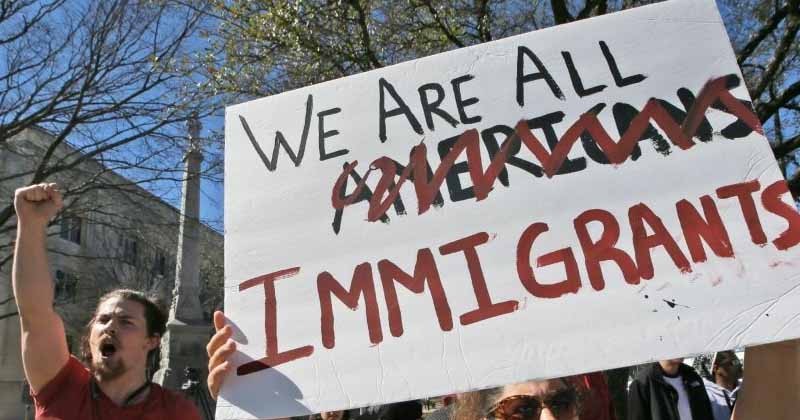
In a dramatic turn of events, peaceful protests that began in Los Angeles against aggressive immigration enforcement have now snowballed into a nationwide movement. Over the past few days, demonstrations have erupted in at least 15 cities across 11 U.S. states, reflecting deepening unrest over the Trump administration’s hardline immigration policies. What started as a localized plea for the release of a handful of detained immigrants has transformed into a broader protest against what critics describe as unconstitutional crackdowns and abuse of executive power.
From Los Angeles to Nationwide Mobilization
The protests were sparked last Friday after several immigrants were reportedly detained at an ICE (U.S. Immigration and Customs Enforcement) facility in downtown Los Angeles. As news of the detentions spread, activists, families, students, and rights organizations gathered in large numbers outside the facility, demanding their immediate release. The rallying cry for immigrant justice quickly resonated beyond California’s borders, fueling solidarity protests across major urban centers.
By midweek, the protests had spread to New York City, Chicago, San Francisco, Denver, Santa Ana, Las Vegas, Atlanta, Philadelphia, Milwaukee, Seattle, Boston, Washington D.C., Dallas, Austin, and San Antonio. In each of these cities, demonstrators raised banners, chanted slogans, and called for the abolition of ICE and a halt to deportation operations.
In Manhattan, New York, protesters assembled near the ICE office, blocking traffic and staging sit-ins. Though the daytime demonstrations were largely peaceful, clashes erupted in the evening when police attempted to disperse the crowd. Several arrests were made, with demonstrators accusing the NYPD of excessive force.
Showdowns in Texas: Protesters vs. Law Enforcement
In Texas, the cities of Austin, Dallas, and San Antonio have become focal points of the protests. In Austin, hundreds of protesters marched to the J.J. Pickle Federal Building — a major ICE hub. Many carried signs that read “No human is illegal,” “Abolish ICE,” and “Families belong together.” Police, however, responded with force, deploying tear gas and arresting 13 people on Monday evening.
Similar unrest was seen in Dallas, where tensions between police and demonstrators escalated following attempts to block access to federal buildings. In San Antonio, protesters remained peaceful, gathering in front of City Hall to voice their concerns. However, state authorities fear the situation may deteriorate further.
Reacting swiftly, Texas Governor Greg Abbott announced the deployment of the National Guard across multiple regions of the state. In a public statement, he emphasized the need to maintain “law and order” and accused “outside agitators” of exploiting the protests to incite violence — a claim activists firmly deny.
Los Angeles Under Curfew as Protests Intensify
In Los Angeles, the epicenter of the unrest, Mayor Karen Bass declared a nightly curfew from 8 PM to 6 AM in parts of the downtown area. This move came after back-to-back days of mass gatherings, clashes with law enforcement, and widespread arrests. The LAPD has reportedly detained over 400 individuals since the protests began — including 27 on Saturday, 40 on Sunday, 114 on Monday, and nearly 200 on Tuesday.
Despite the curfew, small pockets of resistance continue to emerge throughout the city. Protesters have utilized social media platforms to organize flash rallies and share real-time updates. “This is not about one city or one raid — this is about a system that criminalizes people for seeking a better life,” said Marisol Vega, a protester in Los Angeles.
The Trump administration’s response has only fueled more anger. Deploying federal forces, including members of the National Guard and Marines, to control civilian demonstrations has drawn sharp criticism from civil rights groups and elected officials alike.
Trump’s Stance: “Foreign Enemies” and “Liberating” Cities
President Donald Trump, in an address to supporters, doubled down on his administration’s policies, describing undocumented immigrants as “foreign enemies” and vowing to “liberate” cities like Los Angeles from their influence. His remarks have further intensified the national debate on immigration, race, and federal overreach.
Trump’s characterization of immigrant-rich cities as being under siege from “illegals” has drawn strong condemnation from various quarters. California Governor Gavin Newsom accused the president of “attacking American democracy” and warned that using military force against civilians sets a dangerous precedent.
“These are not foreign enemies,” said Newsom in a press conference. “These are fathers, mothers, workers, and students — many of whom have lived in this country for decades. The president’s inflammatory rhetoric is a threat to our constitutional values.”
Constitutional Crisis in the Making?
Legal scholars and civil liberties organizations have raised concerns over the administration’s actions, warning that the use of military personnel in civilian law enforcement operations could constitute a violation of the Posse Comitatus Act, which restricts the use of the U.S. military in domestic law enforcement roles.
The American Civil Liberties Union (ACLU) has already filed multiple lawsuits challenging the legality of the detentions and the militarized response. “What we are witnessing is the weaponization of federal power against marginalized communities,” said an ACLU spokesperson. “This is not just about immigration — this is about the erosion of democratic norms.”
A Growing Movement
Despite arrests, curfews, and military deployments, the protests show no signs of losing momentum. Grassroots organizations, student unions, labor groups, and religious communities are continuing to mobilize. Many see the current movement as part of a broader fight for justice, not only for immigrants but for all marginalized populations in the United States.
“This isn’t just about ICE,” said community organizer Jamal Rivers in Philadelphia. “It’s about dignity, equality, and holding our government accountable.”
As the situation continues to unfold, America finds itself at a critical juncture. With the 2026 elections looming and immigration remaining a polarizing issue, how the government chooses to address this growing wave of dissent may have long-lasting implications on both policy and the soul of the nation.


